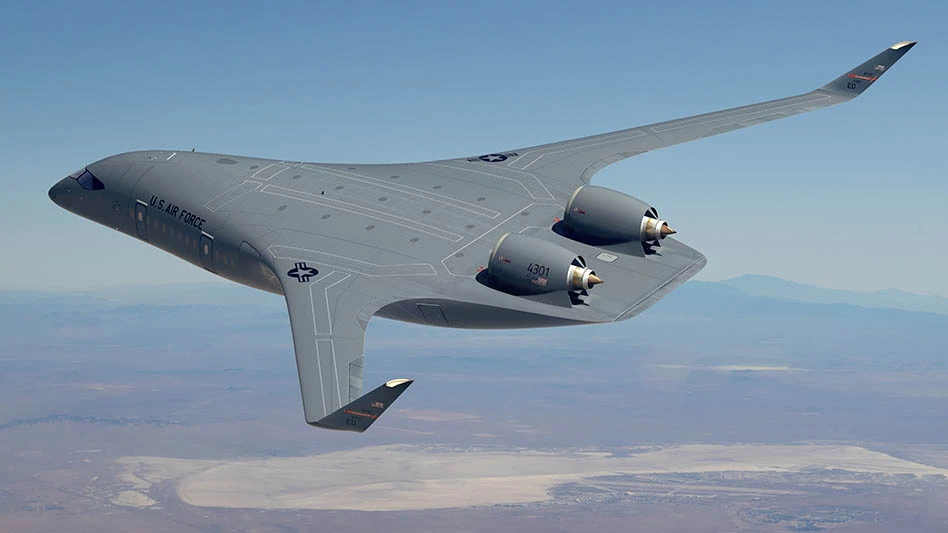
U.S. Air Force graphic
The Department of the Air Force selected JetZero for the next phase of a blended wing body (BWB) prototype aircraft project. Secretary of the Air Force Frank Kendall announced California start-up JetZero's selection at an event hosted by the Air & Space Forces Association.
With a design that differs from a traditional tube-and-wing aircraft, the BWB blends the aircraft body into its high-aspect-ratio wing, decreasing aerodynamic drag by at least 30% and providing additional lift. This increased efficiency will enable extended range, more loiter time, and increased payload delivery efficiencies, capabilities that are vital to mitigating logistics risks.
The effort aims to mature BWB technology and demonstrate its capabilities, giving the department and commercial industry more options for future air platforms.
“Blended wing body aircraft have the potential to significantly reduce fuel demand and increase global reach,” Kendall said. “Moving forces and cargo quickly, efficiently, and over long distance is a critical capability to enable national security strategy.”
“This announcement marks another game-changing milestone for the Air Force in our efforts to maintain the advantage of airpower effectiveness against any future competitors,” said Dr. Ravi Chaudhary, assistant secretary of the Air Force for Energy, Installations, and Environment. A former C-17 Globemaster III pilot and engineer, Chaudhary is leading efforts to ensure efficiencies in operational energy to build greater agility for theater commanders.
Chaudhary mentioned the Asia-Pacific region as a critical area for Air Force operations and the need for aircraft that can use less fuel while having extended range.
Several military transport configurations are possible with the BWB. Together, these aircraft types account for approximately 60% of the Air Force’s total annual jet fuel consumption. The airlift/cargo version, dubbed XBW-1, would be first to be developed, with the design (which JetZero calls Z-5) also considered a candidate for a future aerial refueling aircraft. An added benefit of the BWB design is increased stealth, that although limited, could extend the range the jet could remain undetected by radar.
As outlined in the fiscal year 2023 National Defense Authorization Act, the DOD plans to invest $235 million throughout the next four years to fast-track the development of the dual-use technology, with additional private investment expected. The effort is the result of collaboration between the Department of the Air Force, NASA, and the Defense Innovation Unit, with assistance from the DOD’s Office of Strategic Capital.
While the BWB concept has been around for decades, more recent technology advancements in structural design, materials technology, manufacturing, and other areas have made large-scale production achievable, a Dept. of the Air Force press release notes.
JetZero founder Mark Page pioneered the ultra-efficient airframe with team members Bob Liebeck and Blaine Rawdon at McDonnell-Douglas. He later co-founded DZYNE Technologies where he continued to advance the BWB design in collaboration with NASA.
Co-founder Tom O’Leary joined Page in 2021 to form JetZero and bring the BWB to market. Since then, the team has grown to include former C-level executives from Boeing, Airbus, Learjet, Gulfstream, and others.
Construction of the BWB, featuring a composite structure, likely will be under the supervision of partner Northrop Grumman and its Scaled Composites subsidiary.
The Air Force Operational Energy Office expects completion of initial flight testing as early as 2027. Working with the U.S. Air Force, NASA, and the FAA, JetZero is aiming for entry-into-service by 2030.
Commercial passenger airlines and air freight companies also stand to benefit from the development of BWB technology, increasing available cabin or cargo space while decreasing operational fuel costs.
Latest from Aerospace Manufacturing and Design
- IACMI launches ‘Make It In America’ national outreach campaign
- What’s next for the design and manufacturing industry in 2026?
- OMA and NIMS partner to launch semiconductor technician credentials
- Analysis, trends, and forecasts for the future of additive manufacturing
- BlueForge Alliance Webinar Series Part III: Integrate Nationally, Catalyze Locally
- Blaser Swisslube, NIDEC Machine Tool America partner
- Extrusion crosshead combines concentricity adjustment, fastener-free assembly
- Vertical Aerospace unveils Valo eVTOL aircraft