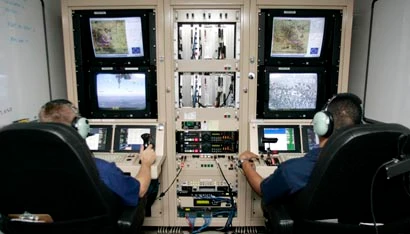
After five years, and 23 extensions, Congress is finally poised to put an FAA bill on the President’s desk for his signature. For the first-time ever, Congress tasked the Federal Aviation Administration (FAA) with coming up with a plan to safely expedite the integration of unmanned aircraft systems (UAS) into the national airspace system. AUVSI, the world’s largest non-profit trade association representing the unmanned systems industry, played an instrumental role in drafting and advocating for the UAS language in the bill.
“Although unmanned aircraft have been around for decades, the rapid technological advancements made by the military in the past decade has matured the technology to the point where we now know we can safely fly UAS to accomplish those tasks that are too dangerous, difficult, dull, or expensive, for manned aircraft,” said AUVSI’s President & CEO Michael Toscano. “UAS are a revolutionary-type technology that will completely alter the way we think about aviation in the future, and this legislation marks the beginning for how the FAA will regulate this fast-evolving industry.”
Some of the major UAS provisions in the FAA bill include:
• Setting a 30 Sept. 2015 deadline for full integration of UAS into the national airspace;
• Requiring a comprehensive integration plan within nine months;
• Requiring the FAA to create a five-year UAS roadmap (which should be updated annually);
• Requiring small UAS (under 55lbs) to be allowed to fly within 27 months;
• Requiring six UAS test sites within six months (similar to the language in the already-passed Defense Authorization bill);
• Requiring small UAS (under 55 lb) be allowed to fly in the U.S. Arctic, 24-hours-a-day, beyond line-of-sight, at an altitude of at least 2,000ft, within one year;
• Requiring expedited access for public users, such as law enforcement, firefighters, emergency responders, etc.;
• Allowing first responders to fly very small UAS (4.4lbs or less) within 90 days if they meet certain requirements;
• The goal is to get law enforcement and firefighters immediate access to start flying small systems to save lives and increase public safety.
• Requiring the FAA to study UAS human factors and causes of accidents; and
• Exempting model aircraft, so long as the aircraft weighs less than 55lbs and follows a set of community-based safety standards.
Latest from Aerospace Manufacturing and Design
- Archer to test Starlink onboard its Midnight air taxis
- System eliminates cage-creep in sliding bearings
- Bodo Möller Chemie signs worldwide supply contract with Airbus
- Sandvik Coromant's CoroTurn Plus turning adapter
- ZOLLER Technology Days & Smart Manufacturing Summit May 13-14, 2026 in Ann Arbor, Michigan
- Walter's TC620 Supreme multi-row thread mill family
- ThermOmegaTech achieves CMMC Level 2 C3PAO certification
- One-touch precision flex locators