Over the course of two weeks of testing, NASA, UND and the MITRE Corp. worked on technology that could one day help unmanned aircraft better integrate into the national airspace system.
“The concept is that we could have technology on board that could sense an aircraft, and if the pilot on the ground doesn’t immediately react, it could maneuver the aircraft away from a possible conflict,” explains Katherine Barnstorff, media relations specialist for NASA’s Langley Research Center.
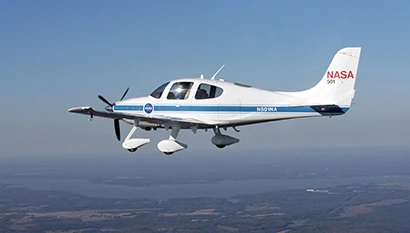
MITRE and UND developed automatic sense-and-avoid computer software algorithms that were uploaded onto a NASA Langley Cirrus SR-22 general aviation aircraft. A supporting UND Cessna 172 flew as a simulated “intruder” aircraft. Ultimately, the NASA plane demonstrated how technology on board allowed it to avoid the UND aircraft. The Cirrus, which was developed as a test bed to assess and mimic unmanned aircraft systems, had a safety pilot in the cockpit, but researchers say computer programs developed by MITRE and UND automatically maneuvered the aircraft to avoid conflicts.
“While we were testing, we also did ongoing updates to both the algorithms we tested,” says Barnstorff. She says UND and MITRE made changes to the software on board the NASA aircraft, and researchers tweaked how the plane measured its proximity to the intruder.
Barnstorff says NASA and its partners are planning additional test flights in 2013. Follow-on testing would feature additional advanced software by MITRE and UND as well as sense-and-avoid software managed by a task automation framework developed by Draper Laboratory.
"One of the toughest obstacles to safe integration of unmanned aircraft into civilian airspace is the availability of technology to mitigate the lack of an onboard pilot who can see and avoid," says Andy Lacher, MITRE’s UAS integration lead, in a press release. "This is a complex operational and technical challenge that requires significant research in the community to address. What we are doing here will help inform and future development of performance standards for sense and avoid."
By Stephanie Levy, AUVSI
Latest from Aerospace Manufacturing and Design
- Archer to test Starlink onboard its Midnight air taxis
- System eliminates cage-creep in sliding bearings
- Bodo Möller Chemie signs worldwide supply contract with Airbus
- Sandvik Coromant's CoroTurn Plus turning adapter
- ZOLLER Technology Days & Smart Manufacturing Summit May 13-14, 2026 in Ann Arbor, Michigan
- Walter's TC620 Supreme multi-row thread mill family
- ThermOmegaTech achieves CMMC Level 2 C3PAO certification
- One-touch precision flex locators