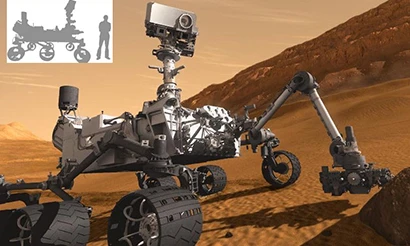
Scientists have taken the control from engineers for the first time following instrument checks, software updates, and test drives on Curiosity's 2.1m long arm for some five-and-a-half weeks.
According to NASA Curiosity mission manager Jennifer Trosper, the rover performed well during all the tests, and expected to drive towards Glenelg, a location where three kinds of terrain intersect.
Curiosity rover reached the red planet's Gale Crater in August, and on its two-year mission it will examine the Martian environment, which will enable scientists to determine if the planet could ever sustain life.
Since its landing, the rover has crossed 109m of the Martian surface, with its last destination being Mount Sharp, which rises from the floor of the crater.
The rover may take days or even weeks to find the right rock, and is expected to cover no more than 40m a day.
Scientists will then study the data received from Mars and decide what they want to explore next.
Meanwhile, Phobos, the largest moon of Mars, is expected to cross the face of the Sun today and the team will try to capture the event.
Although previous Martian missions Spirit and Opportunity caught images of such transits, this is the first time that video footage of it will be sent back to Earth.
Latest from Aerospace Manufacturing and Design
- Archer to test Starlink onboard its Midnight air taxis
- System eliminates cage-creep in sliding bearings
- Bodo Möller Chemie signs worldwide supply contract with Airbus
- Sandvik Coromant's CoroTurn Plus turning adapter
- ZOLLER Technology Days & Smart Manufacturing Summit May 13-14, 2026 in Ann Arbor, Michigan
- Walter's TC620 Supreme multi-row thread mill family
- ThermOmegaTech achieves CMMC Level 2 C3PAO certification
- One-touch precision flex locators