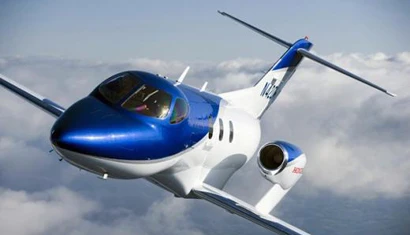
The company, which began researching the potential for a small jet business in the mid-1980’s, will focus on the U.S. and European markets for now.
The aircraft's airframe design reduces cabin and ground-detected noise when overhead as well as offers more cabin space and greater cargo capacity.
The jet will be powered by a pair of fuel-efficient GE Honda HF120 turbofan jet engines, which have been developed under the joint venture between Honda and General Electric.
The company received more than 100 orders for the seven-seater jet in three days when it began taking orders in 2006, promising a quieter engine, 20% better fuel economy over competing models and operational costs of two-thirds or less.
Honda is also planning to equip it with glass cockpit with an integrated avionics system, as well as an autopilot function, anti-icing equipment, and other systems.
The company plans to begin test fly two additional flight test aircraft, F3 and F4, this year.
It is considering beginning structural testing with additional structural test aircraft later this year.
Honda expects the global demand for small business jets carrying five to six passengers to grow to 200 to 300 jets a year in the future, from the current 150 to 200.
Latest from Aerospace Manufacturing and Design
- The Lee Company opens Innovation Center
- Precision XY gantry system
- Archer to test Starlink onboard its Midnight air taxis
- System eliminates cage-creep in sliding bearings
- Bodo Möller Chemie signs worldwide supply contract with Airbus
- Sandvik Coromant's CoroTurn Plus turning adapter
- ZOLLER Technology Days & Smart Manufacturing Summit May 13-14, 2026 in Ann Arbor, Michigan
- Walter's TC620 Supreme multi-row thread mill family