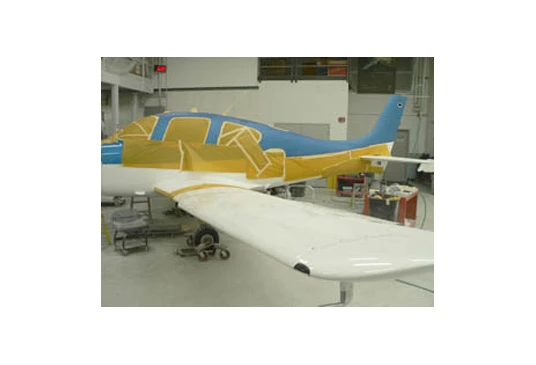
Cirrus has joined with more than a dozen vendors and other partners to create Northern Aviation Industries, a cluster of private and public entities that are helping each other find new markets and customers. It’s not because they don’t expect Cirrus will rebound. Rather, they’ve come to learn it’s not prudent to count so heavily on a single customer.
“We had this explosive growth going on, so we didn’t expend our resources to gain shares of other markets. The aircraft market was so consuming that we made an error in allowing it to be the majority of our business,” Mike Hudyma, vice president and chief operating officer at SCS Interiors, which makes seat cushions and covers for Cirrus.
Like many vendors, SCS was hit hard in October of 2008 when the global economic crisis hit home.
“Cirrus called and said they weren’t taking any more products” due to a backlog of new aircraft and a dearth of sales, Hudyma said.
Those calls were difficult ones for Cirrus, said Todd Simmons, vice president of marketing.
“We tried to be as transparent and candid as possible,” he said, maintaining frequent contact with vendors, even when the news was bad. It was an important gesture, Simmons said, because those vendors are among the company’s most important partners.
But more than two years later, everyone is keenly aware the market for expensive aircraft ($400,000-$700,000) won’t quickly rebound to prior levels.
“I’m certainly more confident than I was 12 months ago,” Simmons said, but “we are still very, very cautious.” Production during 2011, he believes, will be similar to 2010 – about 300 units. That’s down from more than 700 at the company’s peak, when real estate brokers and contractors, considered to be key Cirrus customers, were still in the market. Those market sectors are yet to experience a strong business rebound.
Going full circle:
SCS was among the firms that grew quickly during recent years in tandem with Cirrus, although its roots extended back two decades.
In 1989, David Hudyma purchased Brigham Upholstery in East Duluth, specializing in traditional work such as replacing automobile seat covers. That specialty shifted in the mid-1990s, when Cirrus needed a seat prototype for its new aircraft. Working with seat frames made by another Duluth firm, Northstar Aerospace, David Hudyma and his son Mike landed a contract to supply Cirrus with seat cushions and covers for three airplanes a week.
Soon, Brigham’s 1,500-square-foot shop became too small. In December 2000, the family expanded into a 6,000 square-foot building on Ventura Avenue. By 2001, the firm changed its focus and renamed itself SCS Aircraft Interiors, fulfilling a contract for 10 planes a week. By 2007, that number grew to 16 units.
“Our tables were all occupied, and we were actively involved in making a prototype for the new Cirrus jet,” said Mike Hudyma. “We felt we had enough momentum to move into an ever larger shop.” So the deal was struck, and in January 2009, SCS expanded into 18,000 square feet at 3814 Prosperity Road in the Airpark.
Initially, Hudyma planned to revisit other logical market segments. At the depths of the recession, however, they had all collapsed – RVs, campers and cars. Suddenly, his company was saddled with overcapacity.
SCS has been rebuilding “brick by brick” for the past two years, seeking to regain volume. As part of that initiative, “We rebranded ourselves again, becoming just SCS Interiors,” dropping the word “aircraft,” investigating new markets and creating custom embossed products.
Other Airpark firms were in the same situation. Executives began to share their thoughts, eventually forming Northern Aviation Industries.
“We wanted to discover what products and synergies we have,” said Don Monoco, owner of Monoco Air Duluth and vice chair of the cluster.
Strength in numbers:
When participants first gathered in February 2010, many had not previously met. Today, about 18 entities are represented, said chairman Mike Lundstrom, executive director of the Hermantown Area Chamber of Commerce.
“This first year has been one of identifying our goals and purpose. We want to work as a unified voice for the benefit of individual companies and the aviation industry as a whole,” he said.
So far, informality reigns. The group has no bylaws or dues. It meets every four to six weeks.
“Attendance has been extremely high,” Lundstrom said, because after two difficult years, participants are anxious to exchange rebound strategies.
The cluster has attracted community partners including the Arrowhead Regional Development Commission. Grants from Allete Inc. and the Duluth-Superior Area Community Foundation are funding a branding initiative through WestmorelandFlint.
“We want to make it known that Duluth has a vibrant aviation sector,” said Monoco, a relative newcomer. After retiring as a Chicago business executive, he took flying lessons and first visited Duluth when purchasing a Cirrus airplane. When a ground services opportunity became available in 2005, he jumped at the chance.
He said the cluster’s primary goals include re-utilizing the maintenance facility originally constructed for Northwest Airlines, and expanding airline service, possibly a direct flight to Denver via Sky West, an affiliate of United Airlines.
Later, the group will review future economic development options for the airport, where considerable land remains available, Lundstrom said.
SCS Interiors HR Director Teresa Ganser is helping the cluster write a simple mission statement – the same process she initiated upon joining SCS last spring. Eventually, she envisions the cluster marketing itself at trade gatherings.
Success will be evident when the group develops a strong collective voice, Monoco said, and when individual companies reach their full potential.
Thinking long term:
Hudyma had hoped 2010 would be a rebound year; more correctly, it was a “stabilization year,” he said. But it established the groundwork for a more diversified future.
“We have to keep the pedal to the metal on getting new customers,” he said. “We’ll never rely on a single customer anymore.”
SCS Interiors now is looking for additional business in nontraditional markets, seeking contracts to reupholster seats and other products for commercial businesses including theaters, restaurants and commercial offices.
Monoco believes the airport continues to offer new opportunity for other aviation firms. A growing number of unscheduled charter flights use Duluth International Airport, he said, consuming a variety of goods and services. The city is positioned well, he added, to attract more business from transcontinental flights that need to refuel or resupply.
Meanwhile, Lundstrom said, Lake Superior College (LSC) is working to ensure aerospace firms have a workforce skilled in the manufacturing trades.
Ready for takeoff:
Working with a separate cluster of Duluth aviation companies, LSC operates a flight training school dubbed the Center for Advanced Aviation. Unlike most others, students are trained aboard technically-advanced Cirrus airplanes, not previous-generation aircraft having “steam boiler gauge” dashboards.
LSC’s program is credentialed for single- and multi-engine airplane instruction, instrument flight, commercial licensing, flight instructor training and multi-engine flight instructor training. Working with Lake Superior Helicopter, training is offered for those who want to pilot reciprocating-wing aircraft.
“We’re experiencing a real growth spurt,” said Mona Callies, Ph.D., LSC dean of business and industry. In part, that’s because business travelers seek to avoid the congestion and time-consuming security measures that bog down passenger air terminals.
LSC has benefitted from staff cuts at Cirrus. About three quarters of its flight instructors formerly held similar positions with the aircraft manufacturer.
“We had been traveling across the country instructing other instructors on how to fly Cirrus airplanes,” said LSC flight instructor Kevin Kortuem.
In addition to Cirrus, Monoco Air and Lake Superior Helicopter, other partners in the training program include the Duluth Airport Authority, Minnesota Air National Guard and Northstar Aerospace.
Separately, the 148th Fighter Wing and Monoco sponsor a high school Aviation Day program, said Major Audra Flanagan, the unit’s executive officer. Air National Guard pilots also give presentations to LSC aviation students.
“It’s unheard of to have this many key players working together in a single field,” Kortuem said.
Article was provided by Ron Brochu at BusinessNorth.com