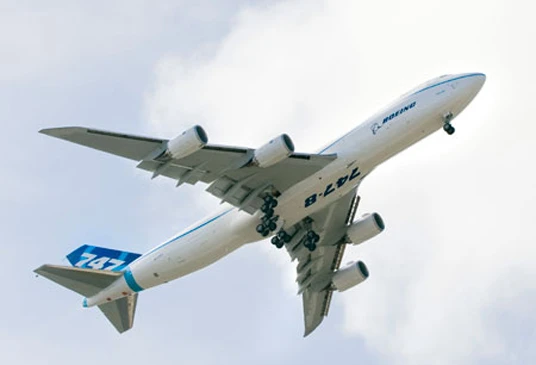
Concerned about potentially hazardous takeoff problems affecting many of the largest Boeing 747 airliners, U.S. air-safety regulators have proposed mandatory fixes to ensure the jumbo jets will climb properly.
The Federal Aviation Administration last week moved to require certain engine-related wiring changes to Boeing 747-400 models. The fixes, according to the agency, are necessary to avoid potentially dangerous retraction of flaps, or panels that deploy from the wings to provide extra lift during takeoffs.
The FAA and manufacturer Boeing Co. discovered that during takeoffs, sensors on a piece of equipment called thrust-reversers can prompt some leading-edge flaps to retract without pilot commands. Thrust-reversers are designed to muffle or redirect air coming out of the engine, but they are supposed to be deployed only after touchdown.
Retracting flaps during critical early phases of flight "could result in reduced climb performance and consequent collision with terrain and obstacles," according to the FAA.
The agency's proposed directive, issued last week, covers nearly 100 Boeing 747s flown by U.S. carriers and equipped with engines manufactured by both General Electric Co. and the Pratt & Whitney unit of United Technologies Corp. Many more planes flown by foreign carriers eventually will be covered by similar directives expected to be issued by air-safety regulators in Europe and elsewhere. The goal is to prevent small movements of thrust-reverser parts during takeoffs from triggering flap retractions.
Latest from Aerospace Manufacturing and Design
- Archer to test Starlink onboard its Midnight air taxis
- System eliminates cage-creep in sliding bearings
- Bodo Möller Chemie signs worldwide supply contract with Airbus
- Sandvik Coromant's CoroTurn Plus turning adapter
- ZOLLER Technology Days & Smart Manufacturing Summit May 13-14, 2026 in Ann Arbor, Michigan
- Walter's TC620 Supreme multi-row thread mill family
- ThermOmegaTech achieves CMMC Level 2 C3PAO certification
- One-touch precision flex locators