Matt Grasson. Can you start by telling me about the testing that was conducted earlier this year?
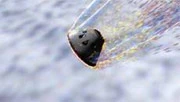
Craig Collier. There were many successful tests of the Composite Crew Module (CCM). There was a test earlier this year, which was probably considered one of the biggest tests – where they damaged the composite on purpose. NASA intentionally put 18 damage locations into the composite structure in the most sensitive areas and we successfully tested the module to 2.0 limit pressures. The testing was to determine if the software was able to accurately predict the stress/strain response of the composite material and the failure strength. The software was used over a three year period for the design. NASA, and NASA contractors throughout the country used the software in a collaborative environment to do trade studies and what-if scenarios and to quickly quantify the performance of these innovative ideas.
M.G. By reducing the weight, did it reduce the strength of the Composite Crew Module at all?
C.C. It has been shown to be as strong as metal. That was the whole purpose of the test, proving the fact that after it was damaged, it still passed the test which means that, by definition, it is strong enough to carry the load that it needs to carry.
M.G. After it was damaged, it still passed the 2.0 test?
C.C. Correct, the strength after damage was sufficient, as it has to carry the same load damaged or not. And it did!
M.G. How long have you been working on this with NASA?
C.C. Three years for this particular CCM project. But we have actually been working on various composites, and other metallic, projects with NASA since 1995. In fact, HyperSizer was the very first software that NASA allowed to be licensed and commercialized as part of the agency’s effort to transfer technology to U.S. business and industry.
M.G. How much longer of a research process is this with NASA before we see more of them actually taking something like this up into space?
C.C. What NASA is trying to do is to prove with the CMM that the design and analysis of composites can be as safe as that of traditional metals. In early 2010 NASA was designing the Ares V as the biggest rocket ever made, larger than Saturn V. The rocket would have had huge composite structure in the interstage, the core intertank, and the shroud. These are very large sections that are based on composites. However, this was cancelled as part of the new direction President Obama provided to the NASA Constellation program. Most likely, in 2011 this same effort will continue as the Heavy Lift Vehicle (HLV). So now, to answer your question, the information that we learned from the CCM has spun off to the other NASA projects.
M.G. Who else is your current research benefitting?
C.C. We are currently working on composite aircraft design projects for Bombardier, Goodrich, Gulfstream, Boeing, and other companies. The airframe and engine designs that we are working on today, you probably won’t see for a few years, but they will be designed with Hypersizer.
M.G. Do you have anything else that you would like to share with our readers?
C.C. NASA designs are in flux today and it will be a while before new structures are flown. The CCM, however, is here and now. The NASA administrator initiated the project. They hand-picked about 30 team members from around the country to work the project, and we were one of those team members. So it had a lot of visibility and is an application that NASA is showing how they can be successful with composites. There’s a lot to be said about the CCM.
M.G. Thank you for your time today. We will be in touch in the future to get an update on how composites and NASA are working together.
Latest from Aerospace Manufacturing and Design
- Archer to test Starlink onboard its Midnight air taxis
- System eliminates cage-creep in sliding bearings
- Bodo Möller Chemie signs worldwide supply contract with Airbus
- Sandvik Coromant's CoroTurn Plus turning adapter
- ZOLLER Technology Days & Smart Manufacturing Summit May 13-14, 2026 in Ann Arbor, Michigan
- Walter's TC620 Supreme multi-row thread mill family
- ThermOmegaTech achieves CMMC Level 2 C3PAO certification
- One-touch precision flex locators