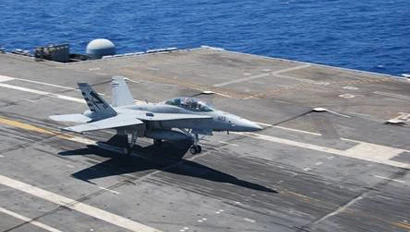
The U.S. Navy program to develop carrier-based, unmanned combat aircraft took a major step forward on July 2, when a Navy F/A-18D surrogate aircraft, emulating an autonomous, unmanned aircraft, successfully performed several approaches to arrested landings on the deck of the USS Dwight D. Eisenhower (CVN-69).
The test was the first-ever carrier landing to use new Precision GPS and Tactical Targeting Network Technology (TTNT) for guidance and control that are being developed by the Navy’s Unmanned Combat Air System Carrier Demonstration (UCAS-D) Program and its industry team including ARINC Incorporated. The full test covered 10 days of flights between June 27 and July 6, using both the F/A-18 and a King Air surrogate aircraft.
UCAS-D technology is designed to take the place of conventional UHF voice communications for control of unmanned carrier aircraft by the Carrier Air Traffic Control Center (CATCC), Air Boss in the tower, and Landing Signal Officer (LSO) on the platform. When fully integrated into aircraft carriers, technologies developed by the UCAS-D program have the potential to provide the digital solutions and precision guidance through all phases of flight to enable future unmanned combat aircraft to operate seamlessly with manned aircraft within the Carrier Control Area (CCA) of 50nm from the carrier.
ARINC has provided program management, engineering services, and subject matter expertise for the Navy’s unmanned programs since 2002. In addition to guidance and control technology for the aircraft, the UCAS-D program requires the upgrade and integration of six existing command and control systems on board the carrier, and development and integration of three new cutting-edge technology systems.
Eighteen ARINC professionals currently serve the UCAS-D aviation/ship integration effort as team leads, engineers, configuration managers, risk managers, and subject matter experts to ensure Navy requirements are properly developed, documented, understood, and implemented. “Our team of dedicated professionals works together and with government engineers and other contractors to ensure success,” said Ms. Sonya Smith, ARINC SATNAV/ATCALS Program Director. “We follow the mantra that failure is not an option.”
Three ARINC personnel served as operators on board the Eisenhower during the 10-day UCAS-D surrogate aircraft test, working as CATCC controllers, Air Boss, and Landing Signal Officer (LSO). Other ARINC personnel served as Aviation/Ship Integration (A/SI) Test Lead on the ship, Beach Detachment Lead ashore, and PGPS Lead ashore.
ARINC Staff Principal Engineer Marty Paulaitis, who worked the LSO platform said, “It was truly great to see the UCAS-D approaches and landings. They came in straight, as if they were on rails, with minimal if any perceived deviations from their glideslope or course. The other LSOs who were watching just turned to me and said ‘Wow!’”
The simulated unmanned landing on July 2 was historic—it was only the second time new technology has been incorporated for approach and landing in Carrier aviation since World War II. Touch-and-go demonstrations were previously conducted in 2001 under the U.S. Joint Precision Approach and Landing System (JPALS) program. Over 42 flight hours in the F/A-18 and King Air surrogates, and a total of 64 successful approaches to touch and go or trap flying two different approach profiles using the UCAS-D system were completed by the time USS Eisenhower turned towards home port at the Norfolk Navy Base.
The Navy said its July 2 exercise demonstrated cutting edge technology for integrating the digital control of autonomous carrier aircraft operations. Captain Jaime Engdahl, Navy UCAS Program Manager, said the successful landing and launching of the surrogate unmanned aircraft “allows us to look forward to demonstrating that a tailless, strike-fighter-sized, unmanned system can operate safely in the carrier environment.”
Latest from Aerospace Manufacturing and Design
- Precision XY gantry system
- Archer to test Starlink onboard its Midnight air taxis
- System eliminates cage-creep in sliding bearings
- Bodo Möller Chemie signs worldwide supply contract with Airbus
- Sandvik Coromant's CoroTurn Plus turning adapter
- ZOLLER Technology Days & Smart Manufacturing Summit May 13-14, 2026 in Ann Arbor, Michigan
- Walter's TC620 Supreme multi-row thread mill family
- ThermOmegaTech achieves CMMC Level 2 C3PAO certification