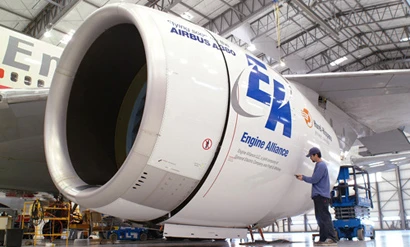
This massive double-decker Airbus A380 plane never fails to turn heads. Launched in 2007, the world’s largest passenger jet can seat as many as 850 people and dwarfs most planes that draw near it on the tarmac. Just the paint alone used to cover its body weighs over 1,000 pounds. What keeps this fully-loaded 617-ton high-tech behemoth aloft? A quartet of next-generation jet engines made by Engine Alliance, a joint venture between GE and Pratt & Whitney.
The American-made engines, called GP 7200, combine the most advanced technology and materials from each of the company’s most successful jet engines, the GE90 and the PW4000. They help the plane burn less fuel, save millions in fuel costs, reduce CO2 emissions, and lower noise. As a result, the A380 is a greener, cleaner, quieter, and smarter kind of plane.
The story gets better. Airbus just revised its performance handbook — a tool used by airlines to predict aircraft performance and engine economics — to reflect an additional one half percent improvement in fuel consumption. It’s the third such positive bump since 2007.
Doesn’t seem like much? Look again. It’s enough to save more than $1 million per aircraft in annual fuel costs and shed additional 3,000 metric tons of CO2. The engine is also remarkably quiet, despite being certified at 81,500 lb of thrust.
GE and Pratt & Whitney have divided the manufacturing of the engine. GE builds the high pressure compressor, combustor and high pressure turbine, while Pratt makes the engine’s fan module, low pressure compressor and low pressure turbine. The GE portion of the work is done in Durham, North Carolina, while Pratt’s is in Middletown, Connecticut. There are 32 GP 7200-powered A380s currently in service - 21 for Emirates, 6 for Air France and 5 for Korean Air.
The American-made engines, called GP 7200, combine the most advanced technology and materials from each of the company’s most successful jet engines, the GE90 and the PW4000.
Latest from Aerospace Manufacturing and Design
- The power of the plasma pen: Revolutionizing adhesion in aerospace manufacturing
- Mazak will show shops how to drive production at Dallas Open House
- Heavy-duty pneumatic flex locators
- Tacky Tape vacuum bag sealing tapes for aerospace composites continue a legacy
- Embraer’s Phenom 300 series is best-selling light jet for 14th consecutive year
- Expanded PushPull connector portfolio
- AEC is Meltio’s official sales partner
- Coolant-thru options for straight, 90-degree, universal live tools