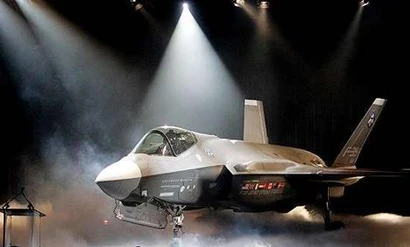
Lockheed Martin Corp. won the F-35 Joint Strike Fighter program in the wake of the Sept. 11, 2001, attacks when U.S. B-52 bombers were pummeling the Taliban and Pentagon spending was unleashed.
Ten years and $66 billion later, the aircraft is still in development, five years behind schedule and 64% over cost estimates. The Obama administration may cancel some models and also cut the Pentagon’s orders.
The plane, envisioned as the affordable stealth fighter for the U.S. and allies, has turned into a budget target.
“I’d blame the program’s setbacks on the fact that we lived in a rich man’s world,” said Jacques Gansler, a former Pentagon chief weapons buyer in the Clinton administration and now a professor at the University of Maryland at College Park. “There has been less emphasis on cost over the past 10 years,” he said.
During that decade, the F-35 cost rose along with the Pentagon’s overall budget for developing and buying new weapons, which increased 62 percent to $208 billion in 2011 from $128 billion in 2001. The jet has been bedeviled by a costly redesign, faulty cost estimates, fluctuating order quantities, and infrastructure built on assumptions of rapid production.
Even so, the plane has not failed or faced crippling technical problems in flight tests, and Lockheed says the jets are meeting test goals. Last month, the Marine Corps version, the most complex variant, demonstrated the first short takeoff and vertical landing on a ship.
Click here to read the entire article:
Latest from Aerospace Manufacturing and Design
- Precision XY gantry system
- Archer to test Starlink onboard its Midnight air taxis
- System eliminates cage-creep in sliding bearings
- Bodo Möller Chemie signs worldwide supply contract with Airbus
- Sandvik Coromant's CoroTurn Plus turning adapter
- ZOLLER Technology Days & Smart Manufacturing Summit May 13-14, 2026 in Ann Arbor, Michigan
- Walter's TC620 Supreme multi-row thread mill family
- ThermOmegaTech achieves CMMC Level 2 C3PAO certification