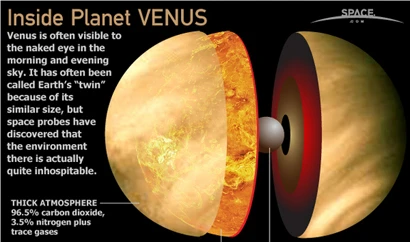
Venus, the black speck of a planet that observers will see scooting across the sun's face June 5, 2012 in a rare transit, is a hellish world, with a host of secrets.
Its sky is choked with clouds of sulfuric acid that drizzle a constant, corrosive rain. The surface temperature is a balmy 932°F, hot enough to reduce lead to a molten puddle. The pressure of Venus's dense, toxic carbon dioxide atmosphere is a crushing 92 times that of Earth's.
Less than a dozen robotic spacecraft – all from the former Soviet Union – managed to touch down on Venus's menacing surface between 1970 and 1984. None survived more than 127 minutes.
The brief bursts of data from those landers, as well as observations from U.S. and Soviet orbiters scanning Venus from aloft, show traces of ancient, temperate oceans that may have boiled off eons ago due to runaway greenhouse heating.
Click here to read the entire article:
Latest from Aerospace Manufacturing and Design
- Archer to test Starlink onboard its Midnight air taxis
- System eliminates cage-creep in sliding bearings
- Bodo Möller Chemie signs worldwide supply contract with Airbus
- Sandvik Coromant's CoroTurn Plus turning adapter
- ZOLLER Technology Days & Smart Manufacturing Summit May 13-14, 2026 in Ann Arbor, Michigan
- Walter's TC620 Supreme multi-row thread mill family
- ThermOmegaTech achieves CMMC Level 2 C3PAO certification
- One-touch precision flex locators