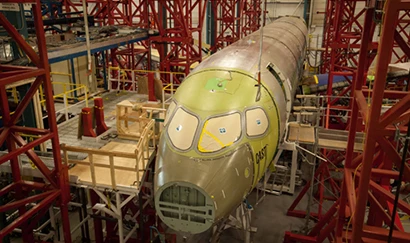
Bombardier officials also announce that testing of the avionics, electrical, flight control, fly-by-wire, hydraulic, landing gear and wiring systems for the CSeries aircraft, as well as virtual flights, are progressing steadily at Mirabel on 'Aircraft 0*' − the on-the-ground Integrated Systems Test and Certification Rig (ISTCR) for the CSeries aircraft.
Located at the company's Experimental Test Facility in St-Laurent, Québec, the CAST is designed to demonstrate the static strength of the airframe and show compliance with certification requirements. The Mirabel facility will be the production site for the CSeries aircraft and the assembly process will include a fully automated moving line using the latest lean manufacturing principles.
"The CAST, FTV1 and 'Aircraft 0' are all key elements in the testing and development of the CSeries aircraft and we are delighted with the progress on each of these three test platforms, said Rob Dewar, Vice President and General Manager, CSeries, Bombardier Commercial Aircraft. "Aircraft 0 is permitting us to validate the CSeries aircraft's systems in an efficient, on-the-ground setting that allows us to work seven days a week and 20 hours a day. Our findings will allow us to optimize the time spent in the flight test program. The integrated systems tests on 'Aircraft 0' are designed to mitigate risks and provide the necessary reliability before first flight. To date, tests have shown no unexpected results and all is going as planned."
With regard to the wings for the CSeries aircraft, Mr. Dewar comments: “Subsequent to the extensive research and test program at Bombardier Aerospace Belfast, which was used to optimize the final production design for weight and performance for the wings, the CAST will be used to confirm their static strength along with that of the other components of the airframe.”
Latest from Aerospace Manufacturing and Design
- Archer to test Starlink onboard its Midnight air taxis
- System eliminates cage-creep in sliding bearings
- Bodo Möller Chemie signs worldwide supply contract with Airbus
- Sandvik Coromant's CoroTurn Plus turning adapter
- ZOLLER Technology Days & Smart Manufacturing Summit May 13-14, 2026 in Ann Arbor, Michigan
- Walter's TC620 Supreme multi-row thread mill family
- ThermOmegaTech achieves CMMC Level 2 C3PAO certification
- One-touch precision flex locators