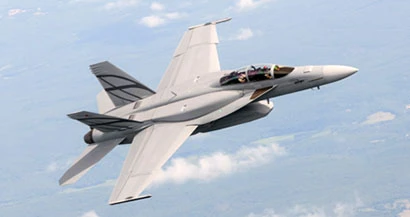
During three weeks of flight testing the Advanced Super Hornet, Boeing Defense, Space & Security and partner Northrop Grumman demonstrated improvements that make the jet much harder for radar to detect and give it more combat range.
Through 21 flights in St. Louis, Mo., and Patuxent River, Md., that began Aug. 5, the team tested conformal fuel tanks (CFT), an enclosed weapons pod (EWP), and signature enhancements, each of which can be retrofitted on an existing Block II Super Hornet aircraft or included on a new jet.
“We continually insert new capabilities into today’s highly capable, already stealthy Super Hornet, and the Advanced Super Hornet is the next phase of this technology evolution,” says Debbie Rub, Boeing Global Strike vice president and general manager. “Boeing and our industry partners are investing in next-generation capabilities so warfighters have what they need when they need it, and so the customer can acquire it in a cost-effective manner.”
Improvements to the aircraft’s radar signature, including the enclosed pod, resulted in a 50% reduction compared with the U.S. Navy’s stealth requirement for the current Super Hornet variant. The tests also showed that the CFTs increase the jet’s combat radius by up to 130nm, for a total combat radius of more than 700nm.
"Even though we added components to the aircraft, their stealthy, low-drag design will enhance the combat capability and survivability of the Super Hornet on an aircraft that has a combat-proven history launching and recovering from aircraft carriers,” says Mike Wallace, the Boeing F/A-18 test pilot who flew the Advanced Super Hornet configuration.
Boeing and Northrop Grumman funded the testing. The companies, along with Hornet Industry Team partners GE Aviation and Raytheon, are investing in more advanced technologies for the Advanced Super Hornet, including internal Infrared Search and Track, an enhanced engine, and a next-generation cockpit.
Latest from Aerospace Manufacturing and Design
- The power of the plasma pen: Revolutionizing adhesion in aerospace manufacturing
- Mazak will show shops how to drive production at Dallas Open House
- Heavy-duty pneumatic flex locators
- Tacky Tape vacuum bag sealing tapes for aerospace composites continue a legacy
- Embraer’s Phenom 300 series is best-selling light jet for 14th consecutive year
- Expanded PushPull connector portfolio
- AEC is Meltio’s official sales partner
- Coolant-thru options for straight, 90-degree, universal live tools