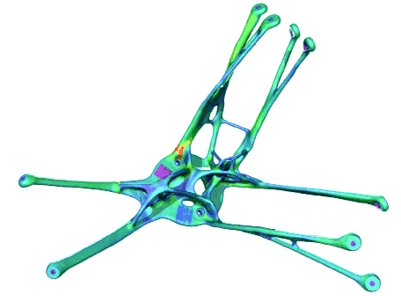
All images courtesy Volume Graphics
Qualifying parts for
aerospace takes on special significance when parts are 3D-printed. Metals and
polymers used to make 3D-printed components are essentially forged on the fly,
so there may be questions about material integrity that must be answered comprehensively
and scientifically. Especially with flight-critical parts, the technology used
to accomplish this task is computed tomography, better known as CT scanning.
Read the full article now!
Latest from Aerospace Manufacturing and Design
- Precision XY gantry system
- Archer to test Starlink onboard its Midnight air taxis
- System eliminates cage-creep in sliding bearings
- Bodo Möller Chemie signs worldwide supply contract with Airbus
- Sandvik Coromant's CoroTurn Plus turning adapter
- ZOLLER Technology Days & Smart Manufacturing Summit May 13-14, 2026 in Ann Arbor, Michigan
- Walter's TC620 Supreme multi-row thread mill family
- ThermOmegaTech achieves CMMC Level 2 C3PAO certification