Editor's Note: This article originally appeared in the August 2025 print edition of Aerospace Manufacturing and Design under the headline “Wheel scrubbing on CNC grinding machines.”


Grinding wheel scrubbing is a specialized in-process wheel conditioning method that remains relatively uncommon and isn’t typically included among the standard features of CNC grinding machines. However, some machine builders may offer it as an optional upgrade or as a retrofit for existing equipment. Alternatively, users may choose to implement the retrofit themselves.
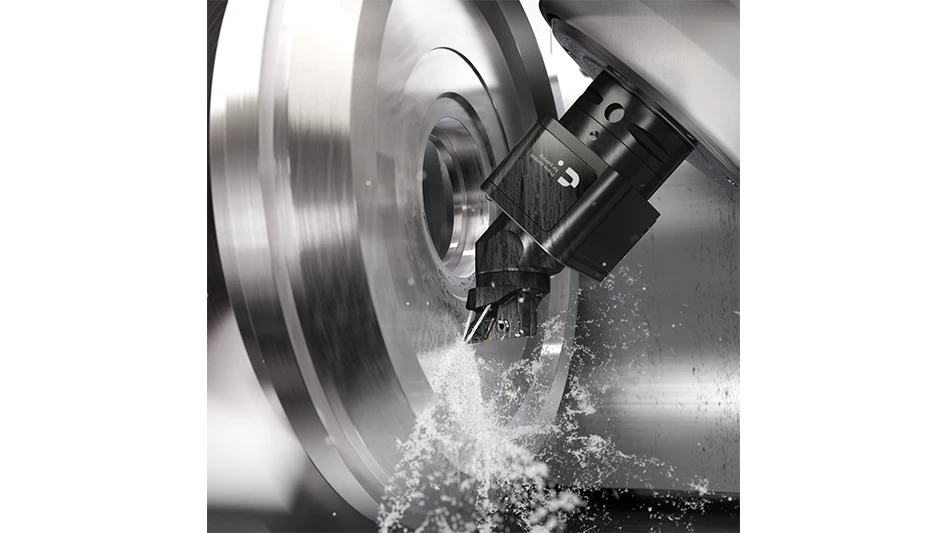
During grinding, wheels can become clogged – a condition known as loading – when material from the workpiece accumulates in the spaces between the abrasive grains. Scrubbing uses a dedicated high-pressure coolant circuit to blast the wheel surface to flush out debris. Wheel scrubbing is intended as an alternative to mechanical in-process conditioning.
Grinding wheels used for in-process scrubbing must possess adequate porosity and bond strength. The porosity enables the high-pressure fluid to effectively flush out debris, while the bond must withstand the force of the coolant without degrading. Under no circumstances should the fluid blast compromise the bond integrity or alter the wheel’s profile or geometric dimensions.
The following types of grinding wheels are generally suitable for in-process scrubbing applications:
- Resin-bonded diamond and CBN wheels with ceramic or metal fillers
- Vitrified-bonded diamond and CBN wheels
- Resin-bonded conventional abrasive wheels
- Conventional abrasive wheels with high porosity or open structures
- Single-layer electroplated diamond or CBN wheels
A good example of CNC O.D. grinding in aerospace is peel grinding of Inconel shafts using vitrified wheels. Other suitable applications for in-process wheel scrubbing include:
- Tool grinding for carbide and HSS, particularly fluting operations requiring heavy stock removal
- Creep feed grinding of superalloys or nickel-based alloys
- Centerless through-feed grinding
- Form grinding of gears made from tough or hardened alloy steels
A secondary coolant system delivers oil at pressures typically ranging from 700psi to 1,500psi. This is usually achieved by feeding a piston pump from the incoming coolant line. A dedicated high-pressure line then supplies the fluid to a nozzle mounted within the CNC grinder. An effective nozzle position is above the workhead, allowing the grinding head to present the wheel to the spray at a controlled, predetermined distance. These nozzles are typically made of carbide to withstand high pressures and feature a flat orifice producing a defined spray width. Since the grinding wheel may be wider than the orifice, the CNC control can compensate by moving the nozzle or the wheel to ensure full coverage across the wheel face.
The operator is responsible for selecting the distance between the nozzle and the grinding wheel, as well as setting the frequency and duration of the fluid blast. Currently, there are no standardized guidelines for these parameters. Instead, optimal settings are typically determined through experience and trial-and-error. Through time, historical data can be developed to guide adjustments based on factors such as abrasive type, bond material, and workpiece material.
Finally, safety must not be overlooked. A dual-channel safety system is essential to ensure the high-pressure coolant can’t be activated while the machine doors are open.
MyGrinding Inc.
https://www.mygrinding.com
Explore the August 2025 Issue
Check out more from this issue and find your next story to read.
Latest from Aerospace Manufacturing and Design
- Assemble-to-order program for gundrilling machines
- #83 Manufacturing Matters - Workholding Roundtable
- Increase speed, productivity, and agility with automation technology
- Real-world manufacturing insights from industry experts
- The Lee Company opens Innovation Center
- Precision XY gantry system
- Archer to test Starlink onboard its Midnight air taxis
- System eliminates cage-creep in sliding bearings