The need for better, more efficient technologies drives competition at a breakneck pace in the aerospace industry. Companies must research and design the latest and greatest to fill everyday needs as well as niche markets. Each issue, AMD will feature a new concept vehicle, part or technology, and what it may mean to the aerospace world.
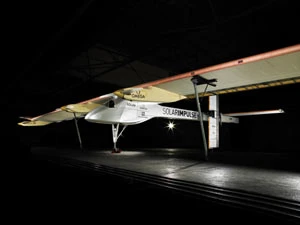
The Solar Impulse is a revolutionary concept that will push back the limits of knowledge in the fields of materials, energy management and the man-machine interface. It is an aircraft with an inordinate wingspan for its weight and of an aerodynamic quality that to this day has not been equaled. It is capable of tremendous resistance, despite its light weight.
From the solar captors to the propellers, it is all about optimizing the different links in the propulsion chain and integrating an environment that is as hostile to the materials as it is to the pilot, all while respecting the weight and resistance constraints.
The construction calls on the most advanced technologies, and stimulates scientific research in the field of composite structures and the means of producing and storing energy. It will be possible to use these results as much in the construction of the aircraft as in numerous other applications useful to society.
On June 26, 2009, the HB-SIA Solar Impulse prototype was unveiled. Six years of intense work, calculations, simulations and tests were needed by the 70-person team at Solar Impulse to complete this unprecedented aircraft. With the wingspan of a Boeing 747-400 and the weight of an average family car, never has such a large craft been built with such low weight. More than 12,000 solar cells mounted onto the wing will supply renewable energy to the four electric motors with a maximum power of 10hp each.
During the day they will also charge the lithium-polymer batteries that will permit the HB-SIA to fly through the night.
The HB-SIA is the first prototype of the Solar Impulse project. Its mission is to demonstrate the feasibility of a complete day-night-day cycle propelled solely by solar energy. After fine-tuning on the ground, the aircraft should make its first test flights between now and the end of 2009. A first complete night flight is programmed for 2010 and will take place over Switzerland.
Explore the August September 2009 Issue
Check out more from this issue and find your next story to read.
Latest from Aerospace Manufacturing and Design
- The Lee Company opens Innovation Center
- Precision XY gantry system
- Archer to test Starlink onboard its Midnight air taxis
- System eliminates cage-creep in sliding bearings
- Bodo Möller Chemie signs worldwide supply contract with Airbus
- Sandvik Coromant's CoroTurn Plus turning adapter
- ZOLLER Technology Days & Smart Manufacturing Summit May 13-14, 2026 in Ann Arbor, Michigan
- Walter's TC620 Supreme multi-row thread mill family