Editor's Note: This article originally appeared in the August 2025 print edition of Aerospace Manufacturing and Design under the headline “Machining strategies for solid end milling aerospace components.”

Inconel and titanium alloys are ideal for turbine blades, exhaust ducts, landing gear, and other high-stress aerospace components due to their strength and heat resistance. However, their high strength and low thermal conductivity make for poor machinability. Achieving optimal tool life, surface finish, and cutting efficiency requires a comprehensive strategy to avoid problems hindering solid end milling.
Effective strategies include optimizing cutting parameters, using advanced tool materials and coatings, and employing efficient cooling and lubrication techniques. Additionally, implementing precise toolpath planning and chip evacuation methods can significantly enhance machining performance.
“The biggest issue when machining high-temp alloys is going to be heat,” says Danny Davis, senior staff engineer, solutions at Kennametal. “We need to take special care in managing the heat, and we do that by using the correct speeds, coolants, coatings, and substrates.”
What creates the heat?
Heat generated by the cutting process doesn’t dissipate as easily into the workpiece or chips for high-temp alloys compared to other materials, leaving the tool and sometimes the part carrying the thermal burden. Every machining operation is essentially a thermal system. Electrical energy entering the spindle is converted into kinetic energy (tool rotation and movement) and heat (due to friction and plastic deformation), affecting chip momentum (material removal).
Chip formation has three distinct phases:
- Rubbing (friction) converts nearly 100% of the energy into heat
- Plowing (plastic deformation) turns approximately 90% of the energy into heat
- Shearing (actual chip separation) generates significant heat
“We know thermal energy is the biggest factor damaging the cutting edge, leading to poor tool life and performance,” says Steve George, senior manager, product design engineering at Kennametal. “It also affects structural concerns like the formation of a white layer from phase changes due to heat. We need to figure out how to lower it, and there are ways we can go about it.”
Managing heat in high-temp alloys
- Use tools designed to cut more efficiently by reducing the specific cutting energy, which measures how much energy is required to remove a unit volume of material. The HARVI I or HARVI II tools are engineered to reduce cutting energy through optimized geometries and coatings. Lower energy equals less thermal stress on the tool.
- With advanced coatings such as Kennametal’s KCSM15A grade engineered specifically for high-temp alloys. With its smoother, thinner layer, it retains a sharper cutting edge, and its enhanced abrasion resistance mitigates the aggressive conditions found in nickel-based alloys. Combined with the right coolant strategy – one with high lubricity – these coatings can significantly extend tool life by reducing material adhesion and heat generation.
- Increasing lubrication with high-pressure coolant systems or minimum quantity lubrication (MQL) can significantly reduce thermal loads, particularly with high cutting speeds. Lubrication doesn’t just cool, it separates contact surfaces, directly reducing energy converted into heat during rubbing and plowing stages.
- In a perfect situation, most heat would exit with the chip. But high-temp alloys have poor thermal conductivity, keeping the heat near the tool. If the cutting tool conducts heat better than the workpiece or chip, it ends up absorbing more of it and wears out faster. By using tools made of materials that insulate rather than conduct, such as ceramics or certain coated carbide, more heat is forced into the chip rather than the tool.
- Time is crucial in heat transfer during chip formation. The longer the tool remains in contact with the material, the more heat can transfer into it. Traditional milling, which involves longer engagement and constant contact, tends to increase heat due to the extended machining time. In contrast, dynamic milling uses smaller radial engagement and keeps the cutter in motion with less surface contact, reducing heat buildup and improving chip evacuation. Adjusting feeds and speeds also plays a significant role. Lower cutting speeds can reduce heat generation, while higher feed rates prevent rubbing and encourage clean shearing, moving the process away from the plowing zone.
Coolant and lubrication best practices
High-temp alloys generate significant heat during cutting, requiring clever coolant strategies:
- Water offers excellent heat transfer but poor lubrication. Use a coolant with a rich concentration of extreme pressure (EP) additives to fight abrasion.
- Air can help with chip evacuation when coolant isn’t an option. Neat oils offer top-tier lubrication but are typically reserved for extreme cases due to mess and maintenance.
It’s not just about volume, it’s also about placement. Ensure the coolant hits the cutting zone directly. Unsuccessfully aimed nozzles waste coolant and leave tools vulnerable. Tools like the HARVI IV series offer through-tool coolant delivery, flushing chips directly from tight pockets or corners while reducing thermal load on the tool.

“Using higher concentrations of coolant helps reduce abrasive wear and manage heat when machining high-temp alloys,” says Katie Myers, product manager, marketing at Kennametal. “High-pressure through-tool coolant ensures effective heat removal and chip evacuation, which is crucial for tool life and part quality.”
Using ceramic tools in a dry-cutting environment
Ceramic tools offer unique advantages when machining high-temp aerospace alloys. Their ability to withstand extreme temperatures makes them well-suited for dry cutting environments where traditional carbide tools would struggle.
“When we talk about ceramic tools, we’re almost always talking about a dry cutting environment,” George explains. “You need to be very careful with your setup because ceramic tools are much more sensitive to tool path and workpiece geometry.”
A key strategy with ceramics is managing heat without using coolant. George notes, “When we’re machining high-temp alloys, heat is a big concern. But ceramic likes heat. So, we want to generate the heat and get rid of it quickly.”
George advises avoiding re-cutting and ensuring good chip evacuation to prevent premature wear or tool failure. He also suggests specific motion strategies: “Step the walls of the pockets. As you step down, move away from the wall with each pass. That keeps the tool away from the heat zone and helps prevent excessive burr formation.”
These careful toolpath decisions are vital when coolant can’t be used. By managing heat through cutting strategy rather than fluid application, machinists can maximize tool life and avoid sudden ceramic failure.
Effective approaches for solid end milling aerospace components
Pocketing techniques and methods of entry: Many aerospace parts are designed with deep, complex pockets. Proper entry strategy and cutter selection make a difference, especially in materials prone to work-hardening and thermal stress. Optimizing pocketing for high-temp alloys is crucial. Plunging is often the most direct method of entering a pocket. This strategy involves dropping the tool straight into the material like a drill. It requires a tool capable of withstanding the axial loads and offering stability during the initial entry.

“Pocketing is one of the most common operations in aerospace, but it can be tricky when you’re dealing with high-temp alloys,” George says. “Choosing the right strategy can make all the difference in reducing cycle time and preserving tool life.”
- Plunge entry works best for small pockets with limited space. HARVI I TE or HARVI II TE solid end mills are designed to plunge directly into the material, offering high flexibility for tight spaces. However, it’s important to ensure the cutting forces don’t exceed the machine’s capabilities.
- Ramp entry is great for deeper pockets and allows for more aggressive cutting. Straight-angle ramping can significantly reduce cycle times but requires a machine with the rigidity to withstand higher forces.
- Helical interpolation is the most stable and efficient pocketing strategy due to lighter depth of cuts.
Corner geometry is another major consideration. Oversized tools can cause excessive radial engagement in tight corners, increasing wear and chatter.
“If you have a 1/2" radius in the corner, then I’d use a 3/4" diameter tool, maybe even 5/8". You need to use a small enough tool to follow the arc of the corner without gouging or over-engagement,” George adds.
Tool selection, depth, and the required rigidity must be balanced carefully. In large pockets with tight corners, a smart method is to start roughing with a larger, more rigid tool, then switch to a smaller tool to finish detailed areas.
Minimizing chatter and maintaining rigidity: Chatter often comes from the machine-tool interface with high-temp alloys. Even the best tool can fail if the spindle or machine lacks the rigidity to absorb cutting forces.
“Chatter occurs when there’s too much movement between the tool and the part, which leads to inconsistent cuts and tool wear,” Myers explains. “The best way to reduce chatter is by ensuring your machine has enough rigidity.”

Chatter can stem from excessive tool stick-out, weak spindles, or incorrect chip thickness. Reducing axial or radial depth of cut, rather than slowing down the entire process, can help with machining. Additionally, selecting the right tool and tool holder will help reduce vibration and prevent chatter. Make sure your tool selection matches the pocket size you’re machining. Using a strong spindle with a good connection to the tool holder can help reduce vibrations. The key is balancing rigidity with the feed and speed to minimize cutting forces.
If chatter persists despite adjusting stick-out and tool selection, reduce the depth of cut to lessen cutting forces instead of slowing down feeds and speeds. This will keep vibrations in check without impacting overall cycle time.
“Even if you have a robust machine, the combination of a long stick-out and a weak spindle can lead to chatter,” George says. “It’s all about balancing tool size, rigidity, and cutting force.”
Cutting parameters and tool life: Tool longevity is directly tied to cutting parameters. Running tools at the right speeds, feeds, and chip loads ensures maximum tool life while preventing premature wear. Speed is crucial when machining high-temp alloys. A speed too fast will burn through a tool much quicker. It’s about finding that sweet spot.
Just as important is chip thickness. Too light a radial engagement without proper feed compensation leads to rubbing, not cutting, generating excess heat and accelerating wear. Always account for chip thinning in your calculations, especially during dynamic toolpaths or finishing passes.
Wall stiffness and support geometry: When machining features like blisks, isogrids, or blades, geometry plays a critical role in maintaining part stability and minimizing deflection. In many cases, adjacent or curved walls help reinforce a feature, offering opportunities to push past standard roughing rules.
“The curvature of the blade actually adds more stiffness into that part,” Davis says. “So, these rules can be a guideline. If the wall has a curvature, or if it has an adjacent wall or a corner or radiuses down at the bottom – all that adds more stiffness.”
The classic 13:1 height-to-width rule for machining high-temp alloys such as Inconel still applies, but features like adjacent walls and internal radii can safely stretch those limits during roughing – especially before the final finishing passes.
Conclusion
Machining aerospace components from high-temp alloys demands more than just the right tools, it requires a comprehensive strategy that addresses heat, rigidity, toolpath planning, and part geometry. By using the right strategies, you can stay ahead of the solid end milling curve in machining complex aerospace parts.
Kennametal Inc.
https://kennametal.com
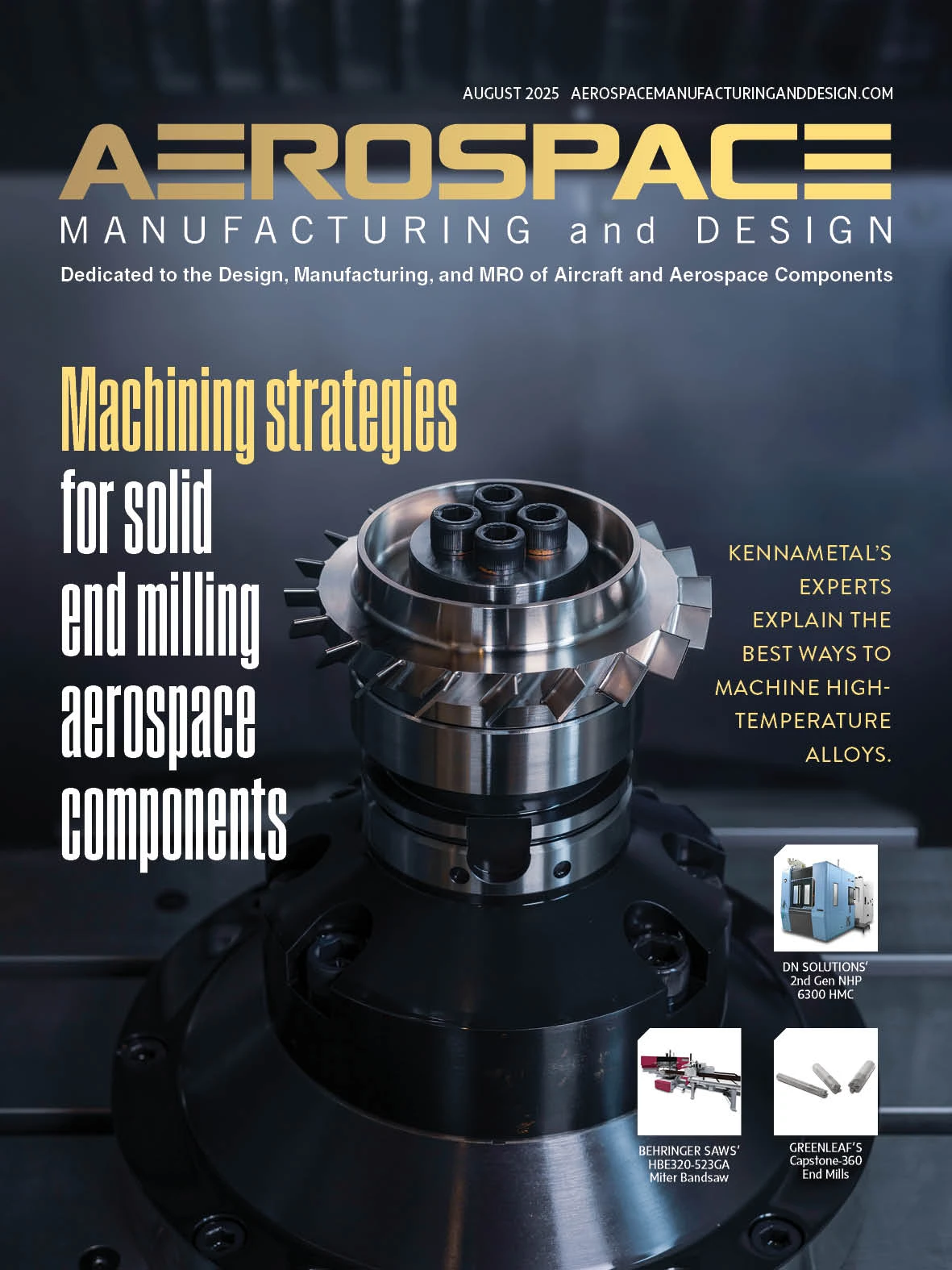
Explore the August 2025 Issue
Check out more from this issue and find your next story to read.
Latest from Aerospace Manufacturing and Design
- Assemble-to-order program for gundrilling machines
- #83 Manufacturing Matters - Workholding Roundtable
- Increase speed, productivity, and agility with automation technology
- Real-world manufacturing insights from industry experts
- The Lee Company opens Innovation Center
- Precision XY gantry system
- Archer to test Starlink onboard its Midnight air taxis
- System eliminates cage-creep in sliding bearings