Rotor blown wing UAS flies in helicopter, airplane modes

Lockheed Martin company Sikorsky has flown its rotor blown wing uncrewed aerial system (UAS) in helicopter and airplane modes. Powered by batteries, the 115 lb (52kg) twin prop-rotor prototype demonstrated operational stability and maneuverability across all flight regimes, and the vertical take-off and landing (VTOL) design has the potential to scale to larger sizes requiring hybrid-electric propulsion.
Sikorsky Innovations, the company’s rapid prototyping group, heads the effort to develop and mature the rotor blown wing design. In just more than a year, the group progressed through preliminary design, simulation, and tethered and untethered flight to gather aerodynamic, flight control, and quality data.
The 10.3ft composite wingspan aircraft completed more than 40 take-offs and landings and performed 30 transitions between helicopter and airplane modes, reaching a cruise speed of 86kts in horizontal flight.
“Our rotor blown wing has demonstrated the control power and unique handling qualities necessary to transition repeatedly and predictably from a hover to high-speed wing-borne cruise flight, and back again,” says Sikorsky Innovations Director Igor Cherepinsky. “New control laws were required for this transition maneuver to work seamlessly and efficiently. The data indicates we can operate from pitching ships decks and unprepared ground when scaled to much larger sizes.” https://lockheedmartin.com/ sikorskyinnovations
RAZOR VTOL achieves fully autonomous flight

Mayman Aerospace completed test flights for its RAZOR P100 autonomous uncrewed aerial system (UAS).
The test program, conducted at the U.S. Marine Corps Air Ground Combat Center at Twentynine Palms, California, validated 18 months of engineering and development efforts. Tests included untethered flights of the RAZOR P100 executing complex flight maneuvers demonstrating the capabilities of RAZOR’s SKYFIELD artificial intelligence (AI)-driven autonomous flight control software.
SKYFIELD will enable multiple RAZOR aircraft to navigate complex environments without human intervention, making critical adjustments in real-time based on operational conditions, adapting to changing mission parameters and environmental factors.
Mayman Aerospace plans on enhancing the UAS’ payload capabilities, extending flight range, and refining the SKYFIELD autonomous decision-making algorithms. https://maymanaerospace.com
Sky Power propulsion equips Sky Canoe UAS

Sky Canoe, an indigenous-owned Canadian company, aims to improve the quality of life in indigenous communities with faster, safer, and more cost-effective delivery of essential goods, food, and medical supplies than traditional transportation.
Sky Canoe’s Nimkii 42-S unmanned aerial system (UAS) has a 2.1m wingspan, is 1.5m long, 0.6m high, reaches a speed of 101km/h, has a flight duration of 3.5 hours, and can carry cargo weighing 9.2kg to a distance of 353km. It’s powered by an SP-55 FI TS ROS from Sky Power Int’l, a single-cylinder, 55cm³ displacement internal combustion engine with an output of 3.0kW at 7,000rpm. It has a dual ignition system, fuel injection, and weighs 2.76kg.
The Nimkii 42-S has advanced detect and avoid functions enabling it to spot birds, UAS, and airplanes, performing evasive maneuvers if necessary. https://www.skycanoe.ca; https://skypower.online
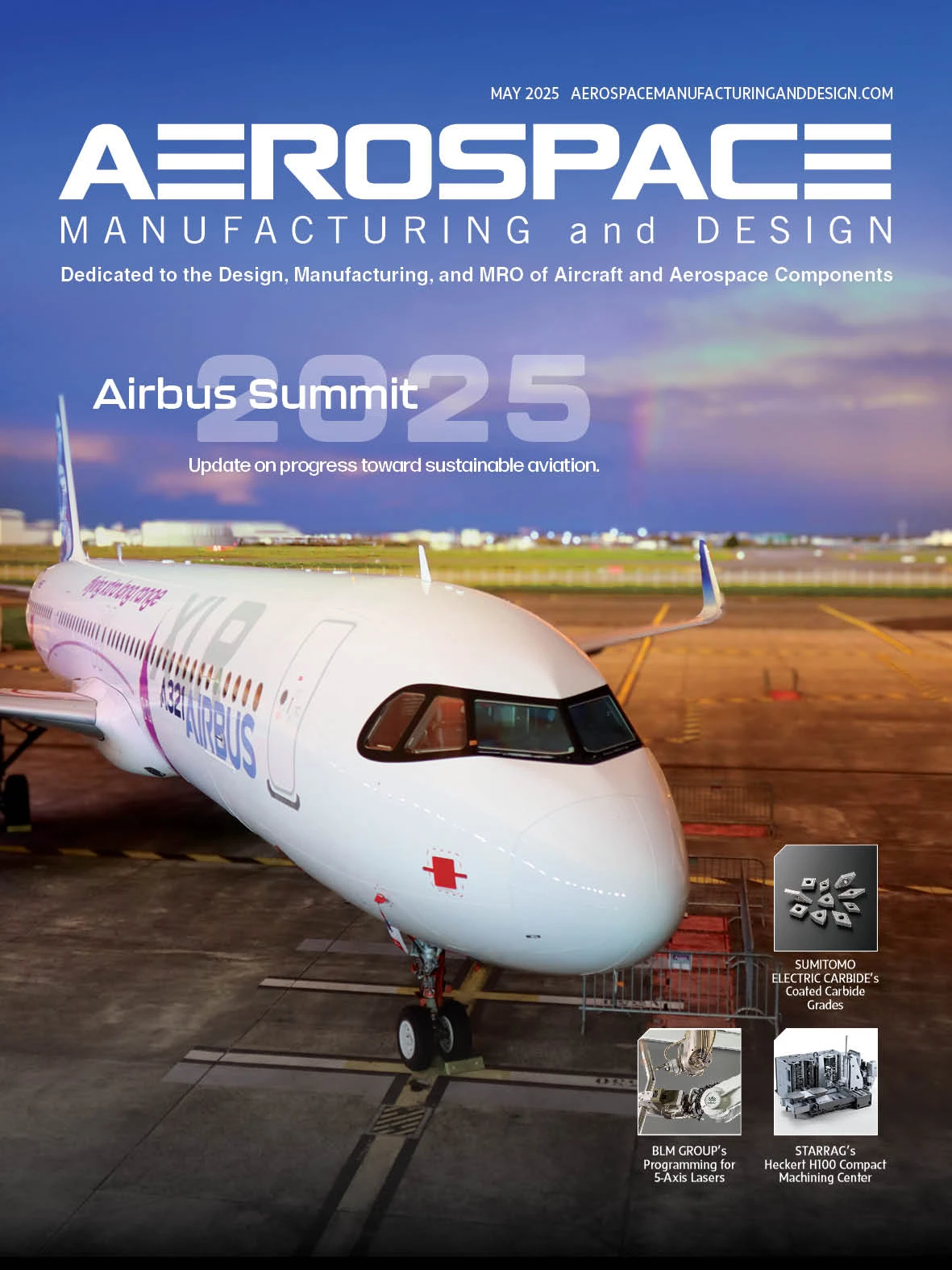
Explore the May 2025 Issue
Check out more from this issue and find your next story to read.
Latest from Aerospace Manufacturing and Design
- Airbus, Kratos to test uncrewed combat aircraft with a European mission system
- Flexure-guided piezo stages
- #84 Manufacturing Matters - Defense Industry Trends with Greenwich Capital Group
- America Makes announces two project calls worth more than $35M in funding
- Join the automation conversation
- Enhanced visitor experience highlighted at TMTS 2026
- This week: Tube bending and workholding solutions to implement now
- Dassault Aviation unveils the Falcon 10X