Advanced technologically, but subject to extreme pressure on costs: this is the situation in which MTU Aero Engines, a first-category supplier of propulsion unit components for civil and military aircraft, finds itself. The multi-stage production of complex, high-cost propulsion unit components requires zero-defect quality. MTU also faces the responsibility of complying with the increasingly strict safety regulations and documentation requirements that affect this high-end market for precision-engineered products. These general conditions arise from the disastrous consequences of a possible product failure: the loss of the aircraft and countless lives.
However, the reason MTU can look to the future with the utmost optimism is to be found on the reverse side of the coin.
The list of players in the global market for propulsion units is limited, consisting of a handful of OEMs and suppliers. Anyone wishing to infiltrate the market should be aware that developing these systems is extremely time consuming and cost intensive, that their subsequent sale returns no profit, and that it is only the receipts from maintaining the systems that facilitates the break-even point to be passed. It may take as many as 15 years to break even.
A company that has an entire series of propulsion units in the development pipeline is a successful company. MTU's core capabilities are not confined to development and manufacture but, in particular, include the maintenance of a considerable number of propulsion units that have been giving service in flying operations for decades.
Successful Production Methods
MTU separates itself from other companies with its significant research and development capabilities as well as accumulated production knowledge. The manufacture of modules for propulsion units and complete propulsion systems calls for the everyday processing of materials such as titanium, Inconel and problematical types of powdered metals. In this connection, the production of "blisks" demands the most exacting standards of machining. The abbreviation stands for "blade integrated disk" and applies to compressor impellers, which, in a multi-stage arrangement, form the core of every compressor, which, in turn, generates the thrust in the corresponding type of power plant.
In keeping with quality requirements and the inordinate value of every component, MTU relies on dependable, high-quality equipment for the production of blisks. Thomas Kubitschek is the head of production engineering for blisks at MTU. Since 1999, he has been in charge of the selection of all the machine tools and equipment forming the blisk production line in the 1,300m2 workshop. Today, various blisk stages for the prestigious EJ200 power plant for the Eurofighter are manufactured here.

Thomas Kubitschek (left), head of production planning for blisks at MTU, has nothing but praise for the WFL M 65 turning/drilling/milling center, and for his collaboration with its Linz-based manufacturer as represented by its regional sales manager, Bruno Reisbeck (right).
Looking back, Kubitschek describes the planning for production as follows: "In order not only to save space, but also to achieve the optimum flow of materials from the very outset, we superimposed the work schedules for the five types of blisks and brought them into alignment. We succeeded in arranging the machines so that for 70% of the work stages, they are used in a sequence affording a unidirectional flow of material. For certain specific processes, such as shot blasting, we routinely direct the components into interconnected production areas."
While machine requirements were established on the basis of capacity considerations, space soon became an issue.

The M 65 not only offers reliable technology for machining, but, thanks to its measuring probe, it also satisfies all the requirements for simultaneous quality assurance.
Kubitschek continues, "When, in considering the work flow, we arrived at the point where the following machining sequence entailed a turning operation, then a drilling/milling operation, then further turning and milling, and finally the shortening of the blades, we had our backs to the wall in terms of space. For the first time, we paid particular attention to the subject of combination machining (turning, drilling and milling) on a single machine and eventually ended up with the firm WFL in Linz."
Quality and Reliability
A degree of sophistication is required of manufacturers when drawing up technical specifications within the framework of a quotation. At present, MTU manufactures titanium blisks by two different methods. In one case, they are milled from a solid piece of metal, a method employing considerable technological resources. In the other case, the individual blades are attached to a prefabricated hub by linear friction welding and subsequently milled to give the impression that this component, too, was made from a single casting.
If the preliminary rough machining is also considered, it can be seen that, in both cases, the blisks represent items of considerable value even before they undergo processing on turning/drilling/milling centers. As with all propulsion units and components, the regulations governing quality are exceptionally demanding. A high degree of processing reliability is demanded of the machine from the standpoint of dimensional, shape and positional tolerances, measured in a few hundredths of a millimeter, and complying with precise, consistent standards of dimensional accuracy.
"In view of the demanding nature of the materials employed, it was necessary for the machines to exhibit a certain stiffness, a characteristic that is not found in every machine," Kubitschek explains. "The final condition of the blisks processed on the WFL machining centers was one of exceptional precision in respect to drill-holes, diameters, sealing seats and grooves, generally the key dimensions for the assembly process and the functional efficiency of the units as a whole."
The combined processing on a single machine allows a very high standard of quality, even in respect to absolute dimensions, Kubitschek continues. "A particular plus point of the M 65 is its B-axis, by means of which we can reliably carry out not only tricky jobs but also routine, simultaneous 5-axis machining. An angled head, directed over the top of the individual machine tool carriers, also enables us to finish the blades to their specified size."
Technology at its Best
Manufacturing manageable annual quantities, short cycle times and minimal non-productive times were, admittedly, of lesser importance in the choice of machine. But the qualities of the M 65, whose linear slides achieve rapid access to the large tool magazine (containing 90 or 120 tools) also guarantee efficient machining.
Bruno Reisbeck, WFL's regional sales manager, describes a particularly tricky use of the B-axis, based on an MTU idea. "Because several blisks, arranged one behind the other, are rotary friction welded to form a drum, the inner welded seam must subsequently be turned. The problem here is that the hub aperture is relatively small, while the inner turning diameter is relatively large. Using a cranked turning tool, the task would be impossible without swiveling, but the projecting length of the tool would automatically damage the hub aperture. Thanks to the controlled B-axis, it is possible to alternately swivel a specially-designed hookshaped tool in and out of the hub aperture with consistent accuracy and without any potential collisions. Swivelling the B-axis in the machining process also helps to keep the rake of the tool at a constant angle throughout."
The measuring equipment of the M 65s supplied to MTU is equally important for achieving processing quality. Each machining center features a tool measuring system and a workpiece measuring system for processing high-value components to a finish. Regular measuring and corrective machining with the aid of the measuring probe are necessary. The machines are subject to nearly constant calibration. Their dimensional accuracy is monitored for any variances in accordance with definitive instructions, and then certified accordingly. These checks and records, which accompany processing operations, have a lasting effect on reducing the costs of final inspections.
Outstanding Service From the Outset
During the construction of the production line in 1999, Kubitschek also had to take the responsibility for countless new machines at the same time. "All our dealings with WFL, from the first contact to the start of mass production, were entirely trouble-free. They even made a similar machine available to us, with the result that we had already carried out a number of trials, programming tasks and process adjustments in readiness for full-scale machining by the time the actual machines were delivered. The fact that, in retrospect, I cannot remember a single noteworthy problem speaks for itself."
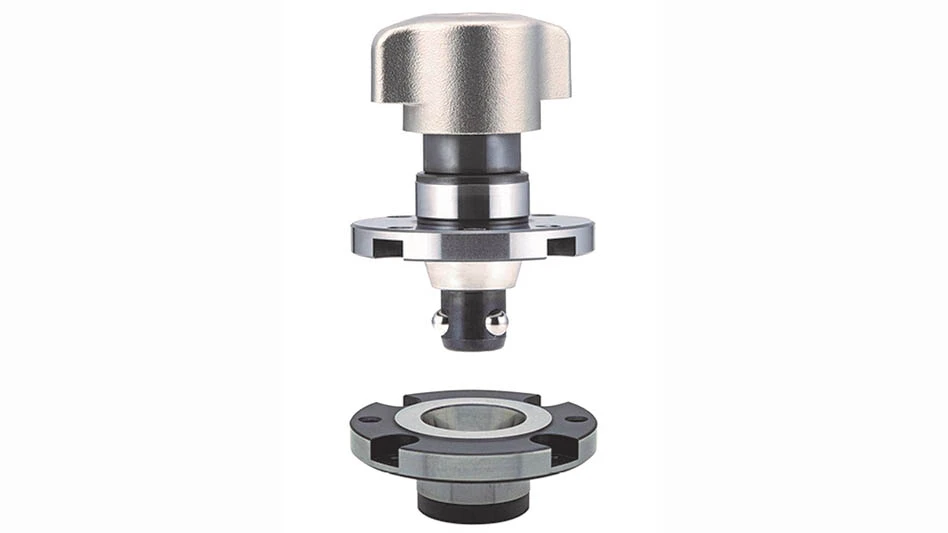
The difficult task of adapting the WFL machines to MTU's Stark rapid clamping system, which is used on all the machines on the line, went off without a hitch.

The production of blisk stages for the high-pressure compressor for the civilian PW 6000 engine makes exacting demands on production engineering.
"The few questions we did have were rapidly and efficiently clarified by means of remote diagnostics via modem. Other aspects such as staff training which, in view of the conversion from single function machines to multipurpose combination machines, was essential, and prompt support in programming complex cycles with the B-axis likewise came up to our expectations," Kubitschek says.
The next Millturn center has already been ordered. This will be assigned to a similarly important position within the new line for the TP400-D6 turboprop power plant for the new Airbus military transport aircraft. This particular M 65 will be equipped with a complete process monitoring system as an additional performance feature.
"With this, we will be able to document the process parameters in parallel with machining operations, particularly drilling processes," Kubitschek explains.
Maintaining and Increasing the Lead
It would never occur to Kubitschek to rest content with any particular production technique, however outstanding.

Stage 1 blisk for the Eurofighter EJ200 jet engine: ‘This component, qualifying for quality standard 1A, embodies almost all of MTU's technological core capabilities,' says Thomas Kubitschek.
"The quality standards laid down for the blisks make us adopt a highly sensitive attitude towards the technology, particularly from the standpoint of the essentially continuous optimization of the processes involved," he says. "While, admittedly, we will continue to use tried and tested methods, the daily performance of which is monitored and proven, we cannot avoid an annual review of efficiency. The implementation of efficiency measures, however, must always satisfy quality requirements and, in turn, safety aspects, in addition to offering financial benefits."
MTU is an example of a German high-tech company that must work continuously on the ongoing aptitude of its core capabilities in order to keep the competition at bay. Kubitschek is on his guard.
"In our industry, the blisk is an object to be envied, especially since it takes on a key function in the manufacture of modern propulsion units. The breakthrough has yet to be made in the civil aircraft manufacturing industry. We must constantly protect and improve upon our high-tech production methods. If they are not subject to continuous tightening down and reviews as to how something can be improved, the day will come when we do not make any more blisks. We work daily at our success, the extent of which determines not only farsightedness and the correct strategy, but also a corresponding amount of luck," Kubitschek concludes.

Explore the September October 2008 Issue
Check out more from this issue and find your next story to read.
Latest from Aerospace Manufacturing and Design
- The Lee Company opens Innovation Center
- Precision XY gantry system
- Archer to test Starlink onboard its Midnight air taxis
- System eliminates cage-creep in sliding bearings
- Bodo Möller Chemie signs worldwide supply contract with Airbus
- Sandvik Coromant's CoroTurn Plus turning adapter
- ZOLLER Technology Days & Smart Manufacturing Summit May 13-14, 2026 in Ann Arbor, Michigan
- Walter's TC620 Supreme multi-row thread mill family