Editor's Note: This article originally appeared in the June 2025 print edition of Aerospace Manufacturing and Design under the headline “Integrated fire suppression solutions for CNC machinery – Part 1.”


We’ve all heard the classic question: What happens if you throw a lit cigarette into a car’s gas tank? First, don’t try it – but the answer might surprise you. In most cases, nothing would happen. That’s because the interior of a gas tank isn’t rich in oxygen, and fire needs oxygen to ignite and sustain itself. While it’s possible that gasoline vapors near the tank’s opening could ignite, the cigarette itself is likely to be extinguished once it hits the liquid fuel. Still, the risk of ignition isn’t zero – which is exactly why it’s not worth testing the theory.
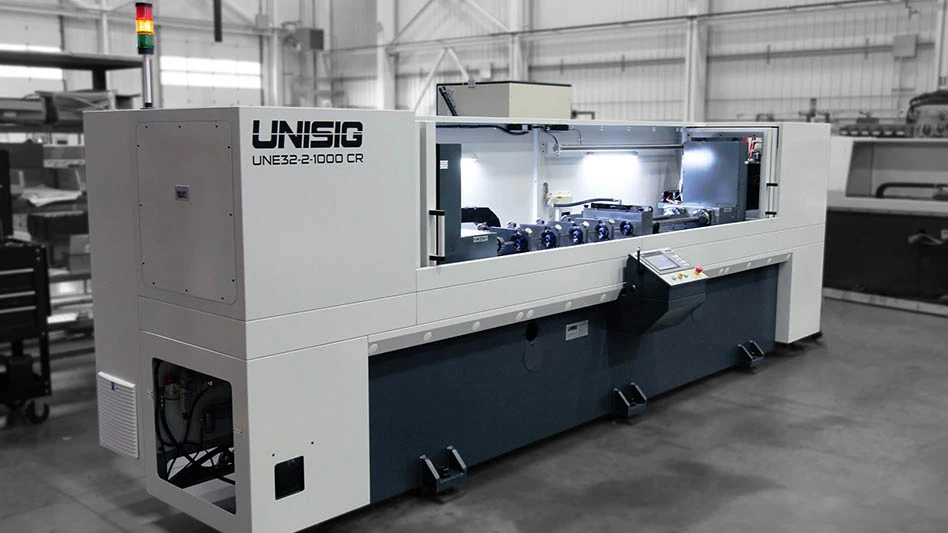
Grinding equipment can pose a significant fire risk, primarily because most machining processes rely on coolant oil. This is especially true for CNC grinders. Unlike dry machining (such as milling), dry grinding is quite rare due to the essential role of coolant in managing heat and reducing friction.
A flash fire inside a CNC grinding machine is typically ignited by fumes and mist, not the coolant oil itself. While coolant oils are highly flammable, it’s the vapor they emit that poses the fire risk. This highlights the importance of rule #1 in preventing fires in CNC machines: integrating an effective and efficient mist extraction system.
When selecting a grinding oil, it’s important to compare the flash point. The flash point is the lowest temperature at which the mist of a liquid can ignite when exposed to an ignition source, such as heat from friction or hot metal swarf. It’s often assumed synthetic oils have a higher flash point than mineral-based oils. However, in practical terms, the commonly used fully synthetic oils in the CNC grinding industry have a flash point comparable to high-quality mineral-based or semi-synthetic oils. Generally, the higher the viscosity, the higher the flash point. Conversely, lower viscosity oils offer advantages such as improved cooling performance, higher feed rates, and extended wheel life. The key is to strike a balance between these two competing benefits.
Let’s explore some of the key causes of flash fires in CNC grinding equipment:
High-speed steel (HSS) and other steel-based alloys generate more heat from friction during grinding compared to carbide.
In lights-out operations, the risk is higher as a flare-up can quickly escalate into a full-scale fire without immediate operator intervention.
Overly aggressive material removal can lead to excessive friction, potentially causing a dangerous situation.
Improper operator setup may result in wheel crashes or excessive heat buildup.
When grinding long, thin parts, such as stainless steel or HSS, inherent distortions in the parts can lead to misloading and wheel crashes.
Inadequate or absent mist extraction is another critical factor.
Worn electroplated wheels, which are difficult to monitor for wear patterns, may expose the steel body and cause friction rather than removing material efficiently.
In my next column, I’ll discuss the various extinguishing agents, the role of an explosion flap, and the importance of proper mist extraction.
MyGrinding Inc.
https://www.mygrinding.com
Explore the June 2025 Issue
Check out more from this issue and find your next story to read.
Latest from Aerospace Manufacturing and Design
- Dassault Aviation unveils the Falcon 10X
- Industrial round bumpers
- Defense Industry Trends webinar with Greenwich Capital Group
- Air Astana finalizes order for 25 Airbus A320neo family aircraft
- Syensqo showcases high-performance sustainable composites at JEC World 2026
- Multi-axis laser processing system
- Daher accelerates industrialization of thermoplastic composite upcycling
- Orizon Aerostructures deploys Flexxbotics platform