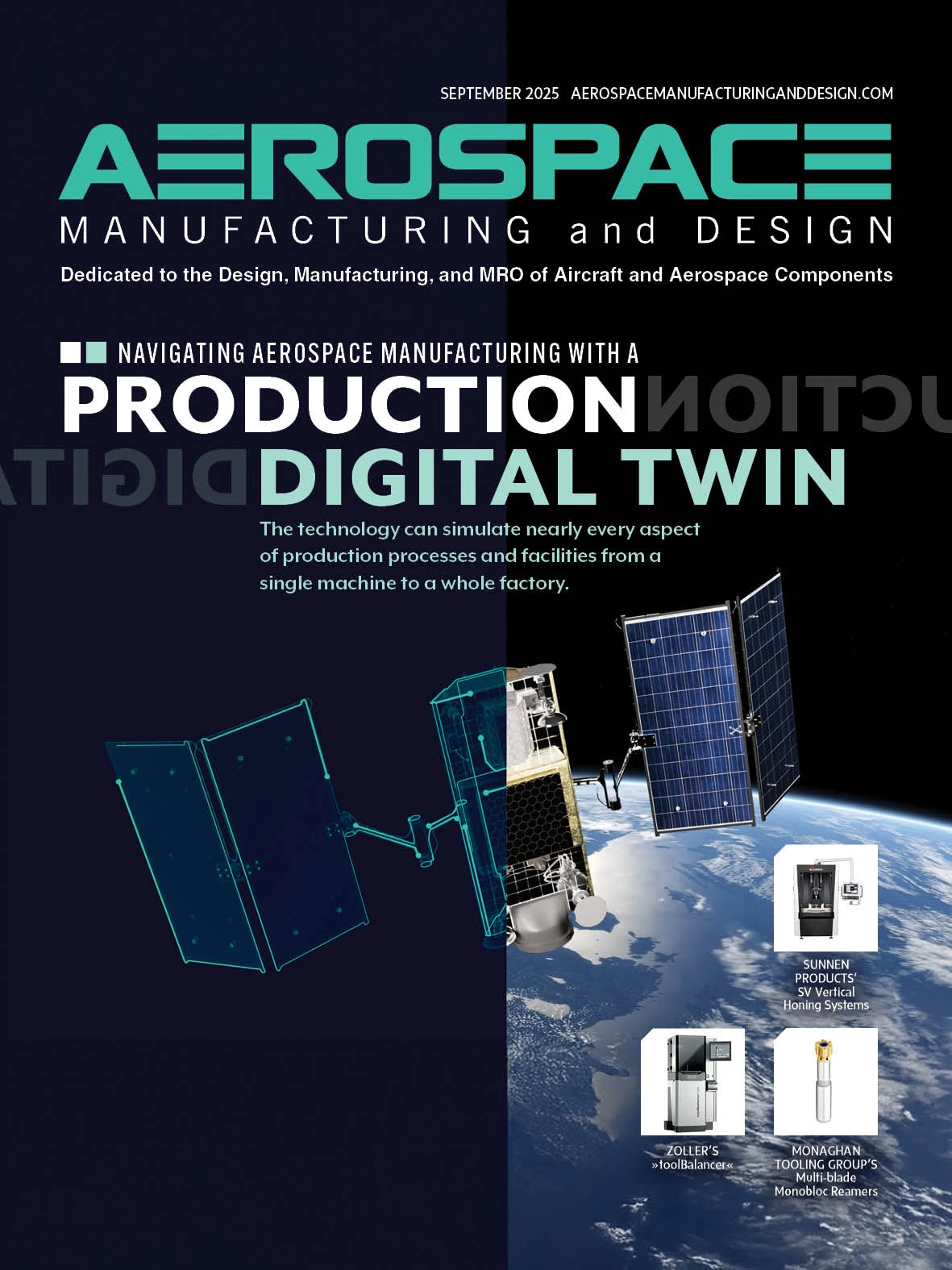
Editor's Note: This article originally appeared in the September 2025 print edition of Aerospace Manufacturing and Design under the headline “Navigating aerospace manufacturing with a production digital twin.”

Think about how much the way people travel and navigate has changed over the past few decades. Where people once relied on paper maps or local sources to find their way to a new location, now everything can be found on a smartphone. With digital tools such as Google Maps, travelers can not only find where they need to go and how to get there, they can access metadata such as menus of nearby restaurants or the timing of subway trains. These navigational tools allow travelers to quickly explore different travel options and create a plan that’s best in terms of quality, timing, and cost. Gone are the days of flying blind.
Aerospace manufacturing needs such navigational insights as it undergoes critical transformation. As the aerospace and defense (A&D) industry seeks to increase production volumes of various aircraft and spacecraft, particularly drones and satellites, manufacturers are exploring innovative strategies in their production processes. Automation, smart manufacturing, and other data-driven technologies offer to boost the output of aircraft and spacecraft while pushing down costs and time-to-market.
The last thing manufacturers want to do when implementing these strategies, however, is fly blind. Without their own form of navigational tools, manufacturers risk implementing new processes at a suboptimal level, or finding errors in their factory plans long after construction, forcing them to spend time and money fixing the issue. They need a tool giving insights into their production processes as early as possible and allowing continuous optimization. That tool is the production digital twin.
What is the production digital twin?
The production digital twin is a key component of a larger, vital tool in digital transformation: the comprehensive digital twin. This acts as a virtual representation of a product throughout its entire life cycle, from design and production to performance. It ensures end-to-end data continuity between all stakeholders in a product, tearing down data siloes and bolstering cross-domain collaboration, traceability, and closed-loop feedback.
As the name suggests, the production digital twin represents the production aspects of the life cycle. Using accurate, real-time data from multiple domains, the production digital twin can model nearly every aspect of production processes and facilities. This can range from simulating a single machine to a whole factory, including assembly lines, the movement of materials, and even individual humans and their interactions with onsite equipment.
With the production digital twin, aerospace manufacturers can make intelligent decisions on transforming their production processes before ever building a physical assembly line.
Planning the perfect factory
When building new factories or retrofitting old ones with new technologies such as automation or smart manufacturing, manufacturers will have similar goals to a traveler planning the perfect trip. They want to make sure their plans work as intended, with minimal chance of issues appearing during or after the construction process. They want to plan their factories to be efficient, their production quality high, and their costs low.
Having insights as early as possible into how factories and production lines would work is key to ensuring these goals are met, and the production digital twin is the tool to make it happen. Rather than designing the factory then building it and testing it afterward to see if all the machinery works as intended for the types of aircraft or spacecraft to be produced, the production digital twin enables engineers to do design and manufacturing planning in parallel.

A factory plan can be modeled virtually, then simulated in a variety of different scenarios. Potential errors can be identified and corrected in this digital environment, saving time and money that would otherwise be spent to fix these errors long after physically building the factory.
Furthermore, these simulations can be run while analyzing multiple key performance indicators (KPIs), such as supply chain delivery, production quality, production efficiency, and other technical, financial, and market implications. This allows manufacturers to optimize their factories and production processes to align with their mission and goals.
Aerospace and defense is a growing industry. Hundreds of billions of dollars will be invested in the next several years to increase production of existing products and to bring new products to market faster than ever before. Should a company hire more staff for its existing factory? Should it upgrade its existing factory with new technology, or build a whole new factory? How do companies decide?
Decisions of this magnitude require investigation across many scenarios. Simulation of these scenarios requires a production digital twin. This digital twin can help companies project costs and results. Digital twins can help develop and optimize processes then develop procedures and even software to operate robots and other machinery.
Production digital twins can simulate everything in a factory, allowing companies to be confident in their decisions in the digital world before millions of dollars are invested in the physical world. Once operational, companies can use what they learned in the virtual world to provide real-time guidance to employees on the shop floor.
Optimizing manufacturing decisions
Optimization of a factory’s production doesn’t stop once the factory is built or transformed. The production digital twin can leverage data during the operation of such factories, providing the ability to continually optimize manufacturing processes. Internet of Things (IoT) sensors can be integrated into factory machinery to feed real-time data into the digital twin where it can be analyzed. This data can be used to find inefficiencies and correct them.

Suppose supply chain or maintenance issues shut down parts of a factory. The production digital twin can be used to evaluate the best way to react to these issues and can also forecast the overall impact on production output. This is a bit like a navigation app when a wrong turn is taken, and it proposes a reroute. The navigation app knows where you are and where you’re going. It offers an alternative path when something goes wrong.
In much the same way, a production digital twin understands the state of a production line and can anticipate problems before they happen so operations can be routed around the issue. Production managers don’t need to experiment on an operational assembly line to fix it. They can experiment with a digital twin and deploy the fix to the physical assembly line right the first time.
Securing aerospace manufacturing’s future
How does a company navigate the upgrade to its production operations? Is it trying to find its way with documents and spreadsheets? Has the company deployed digital transformation to design its products, but not to manufacture them? Companies need navigational insights from a production digital twin.
A production digital twin, as part of a multi-domain comprehensive digital twin, will help plan production upgrades and then optimize operations once the upgrade is deployed. Planning and deploying production operations without a production digital twin is like driving from Paris to Berlin without a paper map. You may eventually get there, but navigating without the latest tools and technology will take longer, and you’ll probably take some wrong turns along the way.
Production digital twins are the best tool to help your company navigate the deployment of new or expanded production capability.
To learn more about Siemens solutions for smart manufacturing, visit: Siemens Digital Industries Software
https://www.siemens.com/aerospace-manufacturing
Explore the September 2025 Issue
Check out more from this issue and find your next story to read.
Latest from Aerospace Manufacturing and Design
- Assemble-to-order program for gundrilling machines
- #83 Manufacturing Matters - Workholding Roundtable
- Increase speed, productivity, and agility with automation technology
- Real-world manufacturing insights from industry experts
- The Lee Company opens Innovation Center
- Precision XY gantry system
- Archer to test Starlink onboard its Midnight air taxis
- System eliminates cage-creep in sliding bearings