Editor's Note: This article originally appeared in the November/December 2025 print edition of Aerospace Manufacturing and Design under the headline “Oklahoma, the MRO capital.”

Its central location has made Oklahoma a hub for maintenance, repair, and overhaul (MRO) activity in the United States, using a skilled workforce to rebuild and repair aircraft, components, and engines.
The state is home to the two largest MRO facilities in the world. American Airlines runs the world’s largest single-site commercial aircraft MRO facility at Tulsa International Airport. Oklahoma is also home to Tinker Air Force Base, the U.S. military’s largest air depot.
According to the Oklahoma Department of Commerce, more than 120,000 Oklahomans are employed in the state’s aerospace and defense industries, which include more than 1,100 manufacturing, MRO, R&D, and military entities.
Aerospace is one of Oklahoma’s fastest growing industries, in part due to legislation the state passed in 2018 creating Oklahoma ACES. A division of the state’s Department of Commerce, ACES offers resources to develop and grow the Sooner State’s aerospace economy. Already an economic pillar, the aerospace and defense industry is Oklahoma’s second largest business (after the oil and gas sector), generating an annual economic impact of nearly $44 billion.
Two examples show the range of MRO services the state offers: Kratos CTS, a home-grown enterprise, and Lufthansa Technik, which is expanding its footprint at Tulsa International Airport.
Kratos CTS
Johnny “Bump” Grant was there at the beginning when Consolidated Turbine Specialists (now Kratos CTS) was founded in October 2012 at Jones Memorial Airport in Bristow, Oklahoma.

“We had a little building, about 3,200ft2,” Grant says. “About 2,400ft2 of that was repair and overhaul, the other 800ft2 was offices. To say it got crowded is an understatement.”
In 2016 they built their current facility and expanded it multiple times. “We had no idea the business would take off the way it did.,” Grant explains. They added an engine test cell in 2018 and in 2019 they were purchased by Kratos Defense.
“We added additional engine lines. We’ve continued to grow. We continue to add personnel,” Grant says. Currently, in Oklahoma, they have about 55 employees plus a dozen more at their Canadian facility.
Kratos CTS’ major activity is overhauling Pratt and Whitney Canada (PWC) PT6A turbine engines powering various fixed-wing general aviation airplanes and PT6T twin pack engines (two PT6A turbines driving a common output reduction gearbox for more power) used on Bell 212 and Bell 412 helicopters.

“In our primary business, we talk about repairing engines, but our primary business is customer support,” Grant says. “It doesn’t matter if it’s Indonesia or Canada or anywhere in the U.S. We have engines running on all seven continents.” Anticipating skeptics, Grant adds, “We do have engines in Antarctica.”
The flow of engines is brisk. Grant says as many as 14 engines have been delivered for overhaul on a single truck. “It’s a lot of engines coming in and a lot of engines going out.”
To expand their customer base and be more proactive in sales, the company hired an expert on growing and managing the sales team. As a result, the company had its largest year in 2023 – 25% more business than the previous year, and 2024 exceeded 2023 by 37%. It’s now on a trajectory to increase sales by double digits from 2024 to 2025.
With the increase in business, how does the company attract and retain technicians?
Grant says they’ve experimented in different ways to get employees in to interview, but their biggest success is hiring locally. The management team is primarily from the area, too.

“The work ethic in this area is unbelievable, and that’s the number one thing we look for: work and attitude,” Grant says. “It’s very important to us for folks not to get negative when something goes wrong, so we encourage everybody to try to make someone in this facility smile every day. That’s hard to do on some days,” he admits, but it works. “We want to create the best working environment that anybody in this world has, and we rely on that to attract good, talented people.”
Grant also credits support from Bristow schools. They started with an aviation focus on students wanting to be pilots through the Airplane Owners and Pilots Association (AOPA) You Can Fly initiative for high school students with STEM pathways in piloting and drones, but they also brought in maintenance classes. “The support from this city, the county, and the state is unbelievable,” Grant attests.
Lufthansa Technik
Tulsa is home to two major operations of Lufthansa Technik, the global MRO, modification, and fleet management company: Lufthansa Technik Component Services (LTCS) and Lufthansa Technik Engine Services (LTES), formerly known as BizJet International.
LTCS, established in 1999 as a U.S. subsidiary of Lufthansa Technik, provides repair and overhaul for approximately 4,400 part numbers, including avionics, hydraulics, pneumatics, fuel systems, and safety equipment. Lufthansa Technik acquired a majority stake in ETP Thermal Dynamics, based in Tulsa, which adds MRO services for heat exchangers, oil and fuel coolers, as well as expertise in manufacturing heat exchanger cores.
Lufthansa Technik has begun construction on phase one of an expansion increasing the LTCS facility’s total size to more than 140,000ft2, up from 115,000ft2. An additional 57,000ft2 expansion (phase two) is in the approval phase. Currently, 250 technician engineers and quality specialists are employed in the Tulsa facility and these expansions would create an additional 250 jobs.
Kenny Walling, director of operations, LTCS Tulsa, says that through this expansion, LTCS strengthens its ability to meet the rising customer demand for high-quality MRO services.
The project also includes the renovation of the existing hangars, with the newly available space being repurposed to expand shop space and boost production capacity.
LTES specializes in engine services for Rolls Royce Tay 611-8 and -8C engines powering a range of Gulfstream business jets. LTES is one of five global repair stations for Lufthansa Technik Mobile Engine Services, supporting International Aero Engines IAE V2500, Pratt & Whitney PW1100, and CFM Int’l CFM56 turbofan engines powering Airbus A320 and Boeing 737 jetliners. The Tulsa facility, with more than 170 employees, includes engine test cells capable of 50,000 lb thrust for validating repairs to Tay, V2500, and CFM56-5B and -7B engines.
Currently occupying 500,000ft2, growth plans call for LTES to offer 50 engine bays for engine repair, plus engine test cells, inspection, back shops, and hangar space.

“Total investment is around $40 million, with more than 200 jobs created in the region after we add all the capabilities during the next three to five years,” says Jennifer Hoffman, Director of Sales, Marketing, and Customer service at LTES.
“We’re the engine Center of Excellence for the Americas. We’ll have room for new engine models [CFM LEAP-1A and -1B] needing overhaul, as well as new and different types of products being developed,” Hoffman adds. “We’ve invested almost $7 million in the past five years, and we’ve got up to $80 million of investment planned for the next 10 years.”
She adds the state has done a lot of work to promote technician recruiting, aviation, and the aerospace industry. “Providing that education in the schools, it’s really been helping us. In the last few years, we’ve had 25% growth in our number of employees.”
Lufthansa Technik LTCS
https://www.lufthansa-technik.com/en/ltcs
Lufthansa Technik LTES
https://www.lufthansa-technik.com/en/ltes
Kratos CTS
https://ctsturbines.com
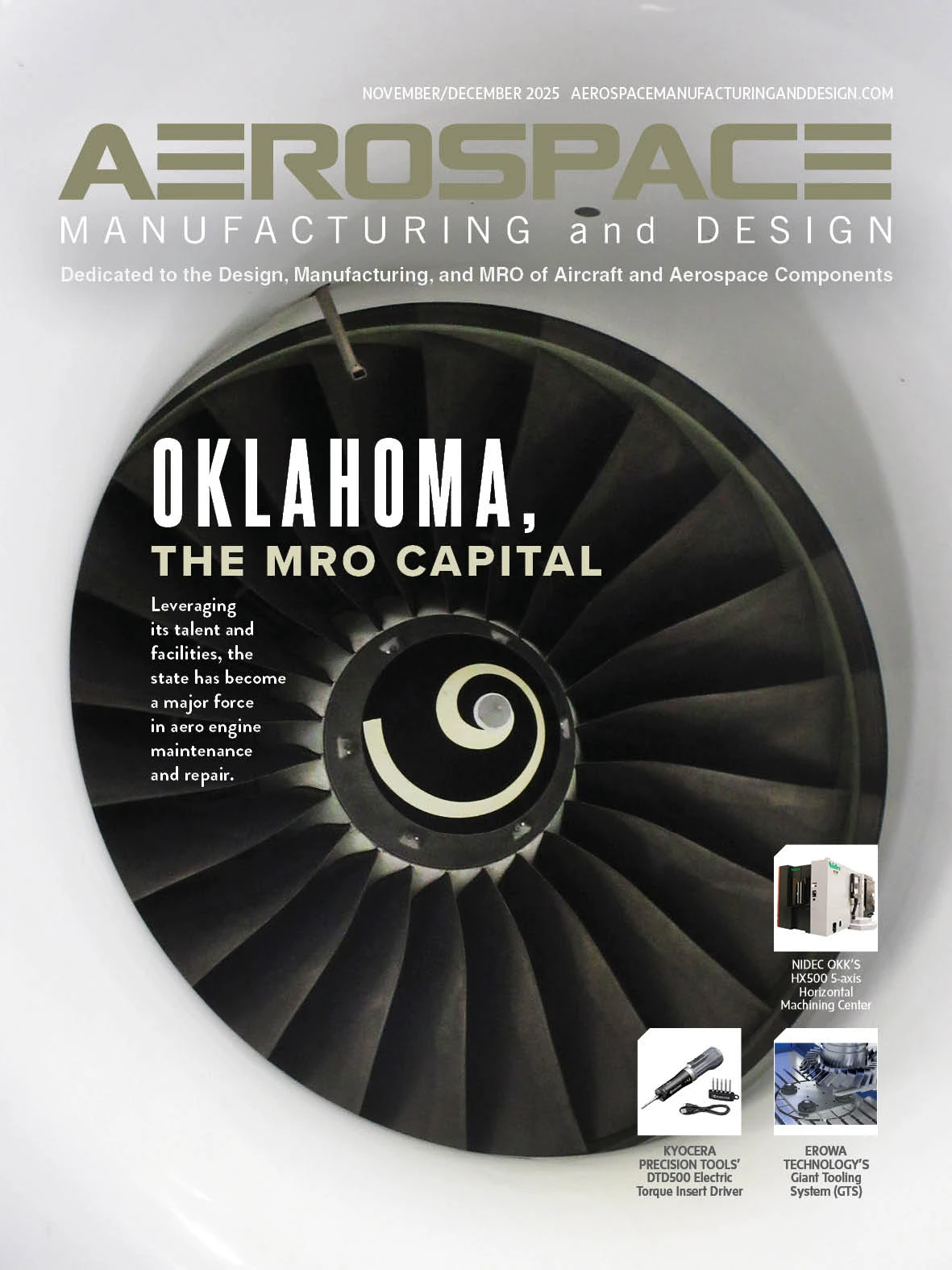
Explore the November/December 2025 Issue
Check out more from this issue and find your next story to read.
Latest from Aerospace Manufacturing and Design
- Assemble-to-order program for gundrilling machines
- #83 Manufacturing Matters - Workholding Roundtable
- Increase speed, productivity, and agility with automation technology
- Real-world manufacturing insights from industry experts
- The Lee Company opens Innovation Center
- Precision XY gantry system
- Archer to test Starlink onboard its Midnight air taxis
- System eliminates cage-creep in sliding bearings