Creep Testers advance to the next level
There are hundreds of part-testing facilities in the United States, and all are under increasing and tightening demands for certification. Creep testers supply critical information within those facilities. Engineers at Virtech Incorporated in Nashua, NH, chose to replace creep tester extensometer's LVDTs with new, highly accurate digital gages from Heidenhain.
When machine parts are required to withstand extreme temperatures, for example 2,000°F in a jet engine, saying that they need to be made of remarkably durable materials is an understatement. This is where highly sophisticated testing equipment comes into play, and where it is important to measure creep.
A creep test checks how long it will take for a part (specimen) to move and begin to reach a particular percent of stress, or "creep." Creep tests are performed at a constant high temperature and load that ultimately determine that material's creep rate.
This is especially common in aircraft applications. This test allows a designer, for example, to know how much a turbine blade in the hot section of a jet engine will elongate over time. Since the tolerances are very close to begin with, the designer must know the creep properties to determine when and if the blade would grow too long to become a problem.
The duration of a single specimen creep test can be weeks, months, or even years, so testers cannot tolerate an equipment failure, especially far into a test period. The reliability of the tester is paramount.

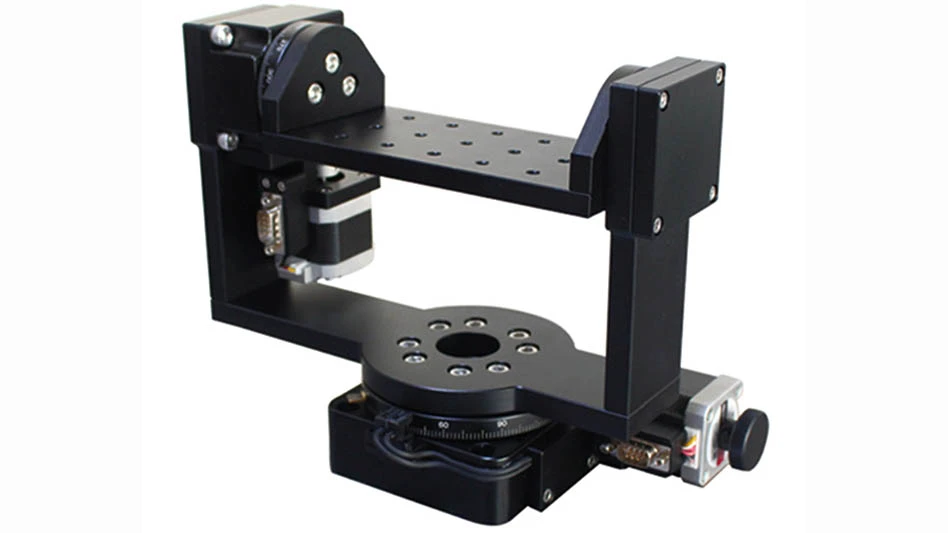
Heidenhain's highly accurate, temperature-resilient Specto/Metro digital gages.
When the tested specimen begins to creep or elongate, it is at that very point where that material or part becomes of no use to its intended user, and possibly even dangerous. It is imperative that its user know that point.
High part standards and required certifications are in place for just these reasons. National and international bodies such as ATSM or ISO, as well as some manufacturers – such as those in the aircraft engine and automotive industries, for example – all require that parts for use in extreme environments meet certain standards and have their creep properties determined. Most creep work is done on materials in the hot section of the engine.
However, many types of general materials such as varying metals, ceramics, and plastics also go through this type of rigorous testing daily.

During a creep test, an extensometer is used to measure the creep length. The extensometer is located inside a frame.
During a typical creep test, an extensometer is used to measure the actual creep length. It is located inside a creep test frame, along with an accompanying control system.
Since World War II and the advent and proliferation of jet engines, creep test machines have been regularly taking measurements all over the world. During much of this time, LVDTs had been the most common measurement source of the extensometers. Recent advancements in technology now allow these LVDTs to be effectively replaced with more accurate gages from Heidenhain.
When brought into the design equation, high level miniature gages allow creep test frames to become digitally automated. With them, higher accuracy levels can be obtained.
Early Designs
When the market for jet engines began to boom, so did the manufacturers of creep test frames. Early frames were simply a gantry with a seesaw-type lever arm at the top. The front of the arm had a hinge rod, to which the specimen to be tested was attached. The bottom of the specimen was attached to the frame.
The other end of the lever arm had a cast metal weight, providing a tension force. The arm, or seesaw, was set up with a 10- or 20-to-1 ratio, resulting in the desired tension with relatively small weights. Then a small tube furnace was wrapped around the specimen. A measurement apparatus, extensometer rods, and usually a dial indicator to measure the creep displacement, was also added.
This test was conducted manually, by checking temperatures and other variables regularly. This was done around the clock, often by two or three testers who would take readings every half hour. This set-up was very labor-intensive and prone to error. Early attempts to automate this process did not have wide success.
The overall design of the creep test frames is still much the same today, while the control system and internal measurement systems or extensometer portions of the frames have evolved over time. There are even some systems that have undergone some automation but still use dial indicators.
The use of LVDTs within extensometers is now a common measurement choice, and has been so for years.
LVDTs are small analog measurement devices that need a signal conditioner to read them. These devices require a calibration procedure after set up, and then periodically as necessary.
Because an LVDT is temperature-sensitive, its placement in an extensometer is critical and its position values have a kind of drift or a natural significant co-efficient of its measurement over time. These often work like a thermometer; the high measurement readings will vary as the room temperature changes.
When in use, testing data will actually reflect when the room air-conditioning cycles on and off. This "drift" noise is less likely with the new digital gages now on the market, as they have a very low temperature coefficient.
New Design
Around the year 2000, the design of an extensometer went through a dramatic shift as the miniature gages became available. The new gages used in the creep testers offer numerous benefits such as high-accuracy measurement capabilities, temperature resilience, and standard reference marks.
Since the elimination of LVDTs, the use of a full-time operator is no longer necessary for conducting creep tests since recalibration and the re-setting of any correction curves that must be done precisely at the right moments with an LVDT are no longer necessary. A more reliable setup is now ensured, using less manpower, which was a major consideration in the redesign.
Also in the redesign, the miniature gage can be seen hanging from the extensometer. Because of its ease of accessibility and installation, it is important to note that the gage can be installed or plugged in at any time dependent upon the application, another benefit of the new design.
Certain materials such as ceramics have a very low creep and require higher accuracy, while plastics have high creep and have a bit more leeway. With the new gages, both ends of the materials creep spectrum can now easily be measured.
Conclusion
In the year 2000, engineers at Virtech Incorporated chose to replace the creep tester extensometer's LVDTs with the new, highly-accurate and temperature-resilient Specto/Metro digital gages from Heidenhain.
Incorporating this digital measurement device, with other control elements, has resulted in an unmatched automated system. Virtech calls it the WIN CCS Creep/Stress Rupture Control System. Applied Test Systems (ATS) in Butler, PA currently manufactures the creep test frames themselves, and uses this new Virtech digital system for automated control.
Pratt & Whitney became the first to use these digital creep test systems in their jet engine manufacturing process.
Many other manufacturers are now part of this trend, as well as some high-quality independent labs such as Dirats Laboratories, BodyCote Testing, Metcut Research, Stavely Services Materials Testing, and U.S. Inspections.
Today, in the U.S., it is estimated that only about 20% of creep testers are equipped with these automated digital control systems.
Though with the hundreds of testing facilities in operation in the U.S., combined with the increasing and tightening demands and certification requirements placed upon them, this is clearly the next level for all.
Heidenhain Corporation
Schaumburg, IL
heidenhain.com
Virtech Incorporated
Nashua, NH

Explore the December 2007 Issue
Check out more from this issue and find your next story to read.
Latest from Aerospace Manufacturing and Design
- Archer to test Starlink onboard its Midnight air taxis
- System eliminates cage-creep in sliding bearings
- Bodo Möller Chemie signs worldwide supply contract with Airbus
- Sandvik Coromant's CoroTurn Plus turning adapter
- ZOLLER Technology Days & Smart Manufacturing Summit May 13-14, 2026 in Ann Arbor, Michigan
- Walter's TC620 Supreme multi-row thread mill family
- ThermOmegaTech achieves CMMC Level 2 C3PAO certification
- One-touch precision flex locators