To remain competitive in today's economic slowdown, products must be made better, faster, cheaper and with more integrity than ever before. This is exactly what i- Nalysis is helping manufacturers do with it is X-ray technology.
Under the direction of Drew Hession-Kunz, president and founder, i-Nalysis pulled together an entrepreneurial team of sales and engineering expertise in May, 2008. Their goal was to develop these technologies beyond the lab.
Besides designing and manufacturing handheld units to perform material analysis, the company also created the Free The Data program, which is a network of scientific and testing instruments that allows authorized users to access the data from any location.
Material Analysis
From barstock to circuit boards, the question that needs to be answered is: What's in there? The X-ray Flourescence (XrF) handheld unit has the ability to specify exactly what grade steel is being used, the chemical breakdown, and even how much lead is in solder. In addition, using a handheld analyzer can determine inorganic elements across the periodic table by telling the user how much of each element is in front of the sample window on the handheld analyzer.

Drew Hession-Kunz
Past to Present
According to Hession-Kunz, people previously used either X-ray tubes or hunks of radioactive rocks known as isotopes to provide the X-rays needed for various testing, such as X-ray imaging or X-ray testing. "The tubes are basically a higher energy light bulb that produce X-rays instead of visible light.
They require either liquid cooling in large units, or a heavy and bulky power supply to create the high voltage needed for X-ray production in these handheld units," Hession- Kunz explains.
Isotopes are generally not the first choice for producing X-rays. They are always on, and there is no way to turn them off, so they must be shielded at all times. Next, the high cost of isotopes requires that they be stored in a secure area. There are also expensive licensing and training requirements for dealing with isotopes. In addition, they begin to slow down over time as they emit their Xrays, so they have to be replaced.
"Pyroelectric crystals have not been used commercially in the past. We have commercialized them for use in X-ray fluorescence analyzers because they are simple, more reliable and require less power," Hession- Kunz explains. We do this by heating one end of a particularly formed crystal.
With certain inputs, pyroelectric crystals produce a stream of X-rays out the other end. The source looks a bit like a tube from an old radio. It can run on a nine-volt battery, although we use a larger one to give it a longer life on the factory floor."
Ease of Use
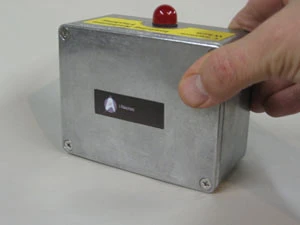
"By using pyroelectric crystals to generate X-rays, we were able to create a smaller, handheld device at a much more affordable price," Hession-Kunz boasts. "These units are generally less than half the cost of current handheld units, and are extremely easy to use. In addition, the unit is extremely compact, measuring 7" x 3" x 1.5".
If you can operate a cell phone, you can run our analyzer. For example, if it is necessary to analyze solder or check for lead levels on a set of circuit boards, you select the proper test from the list of tests on the screen. After the test is complete, the unit will signal a green (good) or a red (bad) light. The only training requirement is a How to use it class, because the instrument produces an X-ray that can be harmful if not properly used," Hession-Kunz explains.
Hession-Kunz also believes the keys to X-ray fluorescence for most contractors are ease-of-use and reliability. "People want to integrate this test tool into their process so they know they are delivering what their customer ordered. The XrF can do this by generating a small squirt of X-rays (about 1/100 of a dental X-ray). The atoms in the user's samples absorb it, followed by the atom fluoresce. The unit then measures that fluorescence response, which is different for each element. Results are calculated in seconds, and a complete analysis with several display options, including a parts per million (PPM) readout by elements can be downloaded," Hession-Kunz explains.
The i-Nalysis team sees the transition from lead solder to lead-free alternatives in circuit boards as an ideal application for the XrF. Many aerospace suppliers cannot be sure if the circuit boards they are working on are lead-free. Because lead-free circuit boards are exempt from Europe's RoHS regulation, U.S. aerospace suppliers need a way to test samples in a fast and accurate manner.

i-Nalysis' X-ray fluorescence instrument is small and easy to handle.
Continous Improvement
Due to increasing environmental regulations that limit what you can and cannot use, and with manufacturers receiving lower quality materials than what they had ordered, as well as mismarked materials and toxins, i-Nalysis is looking toward a significant growth of handheld units over the next several years.
Currently, four units are scheduled to ship in early November that will focus initially on heavy metal testing in military and aerospace electronics. After this initial phase is completed, i-Nalysis will begin shipping units to test for lead in toys and other consumer products.
i-Nalysis
Concord, MA
i-Nalysis.com

Explore the August September 2009 Issue
Check out more from this issue and find your next story to read.
Latest from Aerospace Manufacturing and Design
- The power of the plasma pen: Revolutionizing adhesion in aerospace manufacturing
- Mazak will show shops how to drive production at Dallas Open House
- Heavy-duty pneumatic flex locators
- Tacky Tape vacuum bag sealing tapes for aerospace composites continue a legacy
- Embraer’s Phenom 300 series is best-selling light jet for 14th consecutive year
- Expanded PushPull connector portfolio
- AEC is Meltio’s official sales partner
- Coolant-thru options for straight, 90-degree, universal live tools