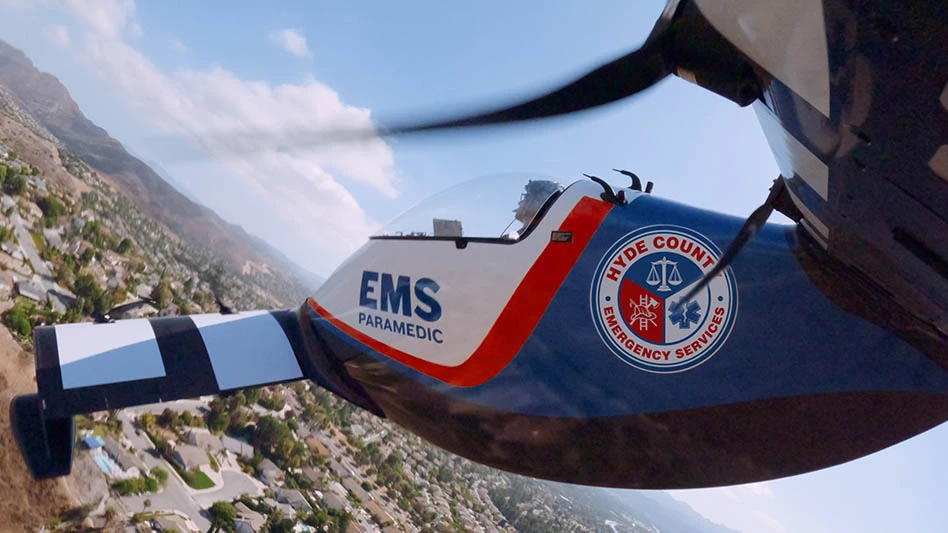
Hanwha Aerospace and General Atomics Aeronautical Systems Inc. (GA-ASI) are partnering to develop and produce uncrewed aircraft systems (UAS) for the global defense market.
The collaboration follows a successful flight demonstration in 2024 when the companies launched a GA-ASI MQ-1C Gray Eagle short take-off and landing (STOL) UAS from a South Korean navy amphibious landing ship at sea.
“Through our collaboration with GA-ASI, we aim to strengthen sovereign defense capabilities, expand Korea’s presence in the global UAS market, and contribute to a more robust ROK-US alliance,” says Dong Kwan Kim, vice chairman of Hanwha Group.
“We know Hanwha is ready to invest to grow a UAS business with GA-ASI in Korea and the U.S.,” says GA-ASI CEO Linden Blue, who supervised the at-sea demonstration.
Hanwha Aerospace plans to invest more than $536 million in development and production facilities for Gray Eagle STOL and UAS engines, building R&D and production infrastructure in South Korea and with GA-ASI in the U.S. https://www.ga-asi.com; https://www.hanwhaaerospace.com
Texas A&M-Corpus Christi to lead center for advanced aviation technologies

The Autonomy Research Institute (ARI) at Texas A&M University-Corpus Christi (TAMUCC) will play a lead role in establishing and operating the Federal Aviation Administration (FAA) Center for Advanced Aviation Technologies (CAAT). Authorized by Congress with annual funding of $35 million for four years, the initiative will advance next-generation UAS technologies for safe integration into the National Airspace System (NAS).
The CAAT will establish, manage, and operate a new airspace laboratory near Dallas-Fort Worth and five flight demonstration zones and testing corridors, including three in South and Southwest Texas.
The center brings together 19 member institutions of the Texas A&M System, as well as partners from the University of North Texas, Southern Methodist University, and other organizations. https://www.tamucc.edu
DZYNE delivers autonomous cargo gliders to US Air Force

Autonomous defense solutions developer DZYNE Technologies delivered multiple Grasshopper expendable aerial cargo glider vehicles to the U.S. Air Force.
Designed for precision aerial logistics, Grasshopper can deliver payloads in high-risk environments while minimizing operational risks for manned aircraft. Grasshopper was created in collaboration with the U.S. Air Force to provide a low-cost logistics solution capable of reaching areas inaccessible to traditional aircraft.
Grasshopper has transitioned from a research effort to a fielded capability in less than 12 months due to close cooperation between the Air Force, DZYNE Technologies, and its users.
DZYNE Technologies expanded its manufacturing footprint in Irvine, California in 2023, using the 125,000ft2 facility to ramp up Grasshopper production and develop a longer-range Grasshopper variant. https://dzyne.com
Explore the June 2025 Issue
Check out more from this issue and find your next story to read.
Latest from Aerospace Manufacturing and Design
- This week: Tube bending and workholding solutions to implement now
- Dassault Aviation unveils the Falcon 10X
- Industrial round bumpers
- Defense Industry Trends webinar with Greenwich Capital Group
- Air Astana finalizes order for 25 Airbus A320neo family aircraft
- Syensqo showcases high-performance sustainable composites at JEC World 2026
- Multi-axis laser processing system
- Daher accelerates industrialization of thermoplastic composite upcycling