Editor's Note: This article originally appeared in the September 2025 print edition of Aerospace Manufacturing and Design under the headline “CNC laser cutting and ablation for superhard tools.”


Cutting tools made from polycrystalline diamond (PCD) are increasingly favored in aerospace manufacturing due to their exceptional performance machining composite materials and metals. Carbon fiber reinforced polymer (CFRP) is widely used in aircraft design to minimize weight and enhance fuel efficiency. Aluminum alloys are valued for their excellent strength-to-weight ratio, corrosion resistance, and reliable structural integrity. Titanium alloys, however, are primarily used in high-strength applications such as engine components and airframes, where superior durability and heat resistance are critical.
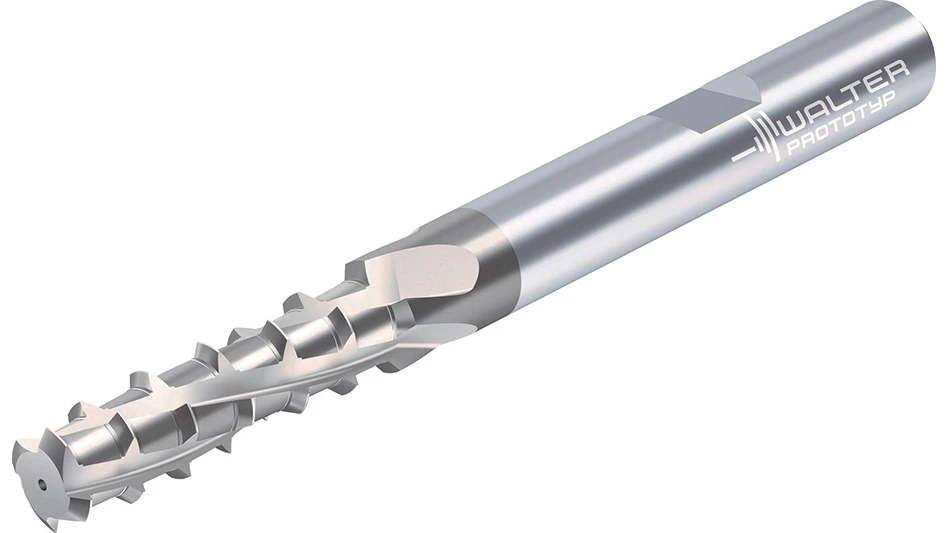
PCD cutting tools offer significant advantages over traditional carbide tools, primarily due to the extreme hardness of diamond, making them exceptionally wear-resistant. Their superior durability reduces the need for frequent tool changes, minimizing downtime and production interruptions. A notable example is drilling the thousands of rivet holes required on an aircraft body – where PCD countersink drills can deliver substantial efficiency and performance benefits.
CNC laser cutting machines are essential for processing ultra-hard materials. These advanced systems operate with five or six simultaneously interpolating CNC axes and employ laser sources equipped with pulse generators in the nanosecond, picosecond, or femtosecond range (a femtosecond equals one millionth of one billionth of a second). The highly focused laser beam delivers rapid localized heating and vaporization of the material along the cutting path, producing clean and precise cuts without any direct tool-to-material contact.
Compared to grinding, laser cutting produces exceptionally sharp and precise cutting edges on PCD tools. While electrical discharge machining (EDM) can also be used to machine PCD, it often causes microscopic surface damage (approximately 0.001" to 0.002" deep), which may be unacceptable for certain applications. For aerospace components, EDM is generally not recommended due to these potential surface integrity issues. We’ll explore EDM and electrical discharge grinding (EDG) in more detail in a future article.
Laser cutting significantly reduces, and often eliminates, micro-chipping on the cutting edge due to its unique non-contact material removal mechanism. Additional advantages include the ability to create intricate and complex geometries – such as tight internal corners, recesses, and pockets – difficult or impossible to achieve with conventional grinding.
Some CNC laser machines can also perform ablation – the controlled melting and vaporization of the surface – which is fundamentally different from cutting. In this process, the laser permanently modifies the material along a pre-programmed path, but instead of cutting through it, only a thin surface layer is removed. Typical applications include creating chip breakers or forming other complex top geometries.
On the carbide side, femtosecond lasers can machine (ablate) an entire micro carbide drill. Laser systems can also process ultra-hard materials such as cubic boron nitride (CBN), chemical vapor deposition diamond (CVD), monocrystalline diamond (MCD), natural diamond, and various ceramic-based materials. CVD and advanced ceramics are becoming increasingly prevalent in cutting tools due to their exceptional hardness, wear resistance, and thermal stability.
MyGrinding Inc.
https://www.mygrinding.com
Explore the September 2025 Issue
Check out more from this issue and find your next story to read.
Latest from Aerospace Manufacturing and Design
- Assemble-to-order program for gundrilling machines
- #83 Manufacturing Matters - Workholding Roundtable
- Increase speed, productivity, and agility with automation technology
- Real-world manufacturing insights from industry experts
- The Lee Company opens Innovation Center
- Precision XY gantry system
- Archer to test Starlink onboard its Midnight air taxis
- System eliminates cage-creep in sliding bearings