Editor's Note: This article originally appeared in the March 2026 print edition of Aerospace Manufacturing and Design under the headline “Charting the digital future for commercial aerospace.”

The commercial aerospace industry finds itself navigating two distinct transformations. On the ground, the priority is deep digital resilience: mitigating ransomware risks, easing supply chain bottlenecks with 3D printing, and augmenting a stretched workforce with agentic artificial intelligence (AI). But look upwards, and there’s a new era of physical expansion, where the rise of reusable launch vehicles is establishing a lucrative, unprecedented market for space maintenance, repair, and overhaul (MRO) and logistics. Here are the key developments to watch:
1 . The new cybersecurity imperative: Closing the vulnerable gaps in the tech stack
The entire commercial aviation network is critical. Its high-value infrastructure ensures the effective movement of people and goods around the world – think transportation of vaccines. The industry’s vulnerability to cyberattacks and their ability to cause widespread disruption has been underscored by recent examples. Thales figures found a 600% increase in ransomware attacks in the aviation sector between 2024 and 2025. Just look to the ransomware attack in September 2025 that crippled check-in systems across multiple major European hubs such as Brussels, London, and Berlin!
At issue is the fact that aviation is still only partially digitally mature. The vulnerability lies in the middle section – where airline, aircraft, and ground systems have been partially modernized but aren’t fully up to date with modern cybersecurity practices.
Check out your software provider
In the year ahead, airlines and regulatory bodies, motivated by recent attacks and the essential role aviation plays in world affairs, and consequential potential targeting by state-sanctioned actors, will mandate a significant push for digital modernization across the entire industry. This will compel all major airlines and airports to implement up-to-date, modern cybersecurity practices for all operational systems, closing the middle section gap to counter potential threats.
Airline operators need seamless agility and resilience to stand any chance in the cybersecurity battle. Airlines and MROs must ensure their software provider adopts a clear security posture, constantly addressing vulnerabilities with frequent updates using an evergreen approach, and ideally, designing out vulnerabilities from the beginning.
2. Supply chain resilience: The rise of 3D printing & digital thread
Supply chain challenges for spare parts availability persist in commercial aviation, driving it back to the top of the list of issues facing the aviation maintenance industry. Leading airlines and air operators must think outside the box and adopt innovative strategies to maintain operational readiness. One potential solution has been to use Parts Manufacturer Approval (PMA) parts, but some airlines face considerable hurdles here as lessors often refuse to allow PMA parts on their aircraft.
Even if used as a stopgap, airlines are forced to swap them out at time of lease return, meaning they’re still subject to the main suppliers’ limitations. However, other parts supply solutions are on the horizon.
3D printing goes mainstream
There are promising signs ahead of ongoing efforts by FAA and EASA regulators to clarify how 3D-printed parts can be used in certain applications. Additive manufacturing (AM), combined with the digital thread, could help solve supply chain bottlenecks by allowing parts to be produced quickly and in proximity to where they’re needed. This technology offers a solution for maintaining older aircraft more efficiently, as digital files for specific parts replace the need to store molds and retool assembly lines potentially decommissioned years before.
Following a formal loosening of regulatory constraints, 3D-printed parts will become a mainstream, more accepted solution. Rapidly producing non-critical and older aircraft components will dramatically streamline MRO processes and establish 3D printing as a driver of supply chain resilience in an industry continuing to feel the pain of supply chain issues.
We’re already seeing this shift with certified 3D-printed engine components and heat exchangers handling super-complex geometries not achievable through traditional manufacturing, such as those on the GE Catalyst turboprop engine and the 3D-printed air-to-air heat exchanger flying on the Cessna Denali.

3. Industrial AI provides a helping hand in the MRO hangar
It’s clear technician shortages won’t be solved in the next 12 months. Despite technician certifications rising, The Pipeline Report from the U.S. Aviation Technician Education Council (ATEC) and Oliver Wyman shows increasing demand, and projected retirements were expected to leave commercial aviation with 10% fewer certified mechanics than needed in 2025.
The question becomes: how can we help the technicians we have do more? One answer is to digitally augment the maintenance technicians to improve overall efficiency. This is where applications of agentic AI are stepping up. One impactful application of this AI will be creating a troubleshooting agent to support maintenance technicians. This generative AI co-pilot will navigate the extraordinary complexity of maintenance documentation, such as Airworthiness Directives (ADs) and Service Bulletins (SBs).
All hands on deck – including digital ones
The ideal agent will help navigate complex reference documentation such as aircraft maintenance manuals (AMMs), component maintenance manuals (CMMs), troubleshooting manuals, or the in-process control (IPC) while pulling up pertinent SBs or ADs. The co-pilot could suggest it’s a potential recurring fault and surface which repairs failed to work previously. Such a co-pilot could, in another scenario, suggest the likely candidates for troubleshooting tasks including historic success rates and time to execute. It could even request the required parts automatically, so they’re waiting.
Expect troubleshooting agents to move out of the pilot phase and into deployment within the maintenance operations of airlines and MROs. These agents will serve as a digital co-pilot enhancing the productivity of the existing, experienced workforce while helping close the knowledge gap for newer technicians.
4. Beyond earth: The growth of the space aftermarket
Looking further skyward, an aftermarket opportunity is emerging beyond Earth’s stratosphere. The new aftermarket is being driven by a proliferation of satellites deployed for communication, observation, and scientific purposes, combined with the rise of reusable vertical-landing rockets such as the SpaceX Falcon 9 and the newly developing Starship. Commercial space tourism is now adding a third catalyst, with reusable spaceflight vehicles that must be maintained to rigorous safety and compliance standards between flights. Together, these shifts are creating an entirely new MRO market for launch platforms themselves, which now require a formal sustainment process rather than simple disposal after a single use.
MRO in space
Orbital vehicles mostly have been treated as disposable assets with a finite operational life. Bringing spacecraft back down to Earth hasn’t been feasible, and sending repair systems up has been equally impractical. The advent of self-healing materials is beginning to shift this paradigm by enabling spacecraft to autonomously repair micro-cracks and structural degradation in orbit, as demonstrated in recent aerospace research on self-healing composites. At the same time, dramatically lower launch costs mean in-orbit servicing and repair are becoming feasible for the first time.
Launch and space-platform MRO is rapidly emerging as the next frontier. Blue Origin’s multi-use Blue Ring platform illustrates how reusable vehicles will create entirely new sustainment markets. In parallel, NASA’s In-space Servicing, Assembly, and Manufacturing (ISAM) framework highlights how satellites and launch systems will require formal sustainment infrastructures rather than being treated as disposable.
Research shows the Space Logistics Market Size will grow to $19.8 billion by 2040, with large growth driven by on-orbit servicing, assembly, and manufacturing, as well as last-mile logistics. The ripple effect during the coming years is the once disposable space assets will require sustainment and support strategies to maximize availability and efficiency and further reduce the costs of space operations. This means maintenance must be built into the asset management life cycle. Manufacturers must make sure vehicles are ready for use and re-use, and critically, are 100% operational when they are required.
The digital imperative
As we move through 2026, commercial aerospace faces a critical digital mandate, charting the course for resilience and new opportunities. The industry and software suppliers alike must step up because supply chains are still fragile, and maintenance crews and parts are still in short supply.
Establishing a strong digital foothold now can allow commercial aerospace organizations to leverage currently available tools for 3D printing and AI-enabled MRO and also enter a new stratosphere as space becomes the next frontier for aftermarket opportunity.
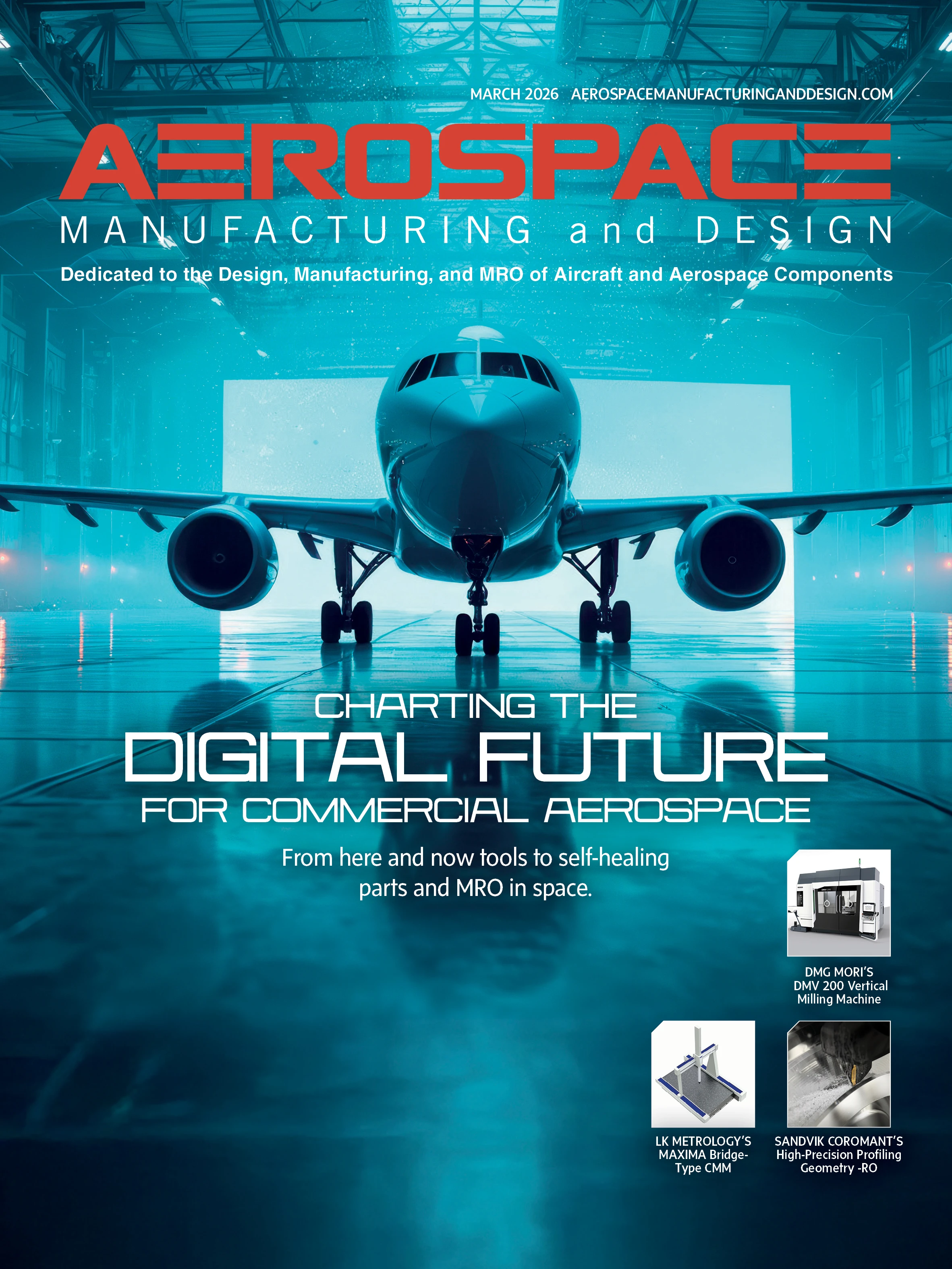
Explore the March 2026 Issue
Check out more from this issue and find your next story to read.
Latest from Aerospace Manufacturing and Design
- The Lee Company opens Innovation Center
- Precision XY gantry system
- Archer to test Starlink onboard its Midnight air taxis
- System eliminates cage-creep in sliding bearings
- Bodo Möller Chemie signs worldwide supply contract with Airbus
- Sandvik Coromant's CoroTurn Plus turning adapter
- ZOLLER Technology Days & Smart Manufacturing Summit May 13-14, 2026 in Ann Arbor, Michigan
- Walter's TC620 Supreme multi-row thread mill family