Editor's Note: This article originally appeared in the March 2026 print edition of Aerospace Manufacturing and Design under the headline “Composite can heal itself more than 1,000 times.”

Researchers have created a self-healing composite tougher than materials currently used in aircraft wings and other applications – that can repair itself more than 1,000 times. The researchers estimate their self-healing strategy can extend the lifetime of conventional fiber-reinforced composite materials by centuries compared to the current 15-to-40-year design-life.
“This would significantly drive down costs and labor associated with replacing damaged composite components, and reduce the amount of energy consumed and waste produced by many industrial sectors – because they’ll have fewer broken parts to manually inspect, repair, or throw away,” says Jason Patrick, corresponding author of the paper “Self-healing for the Long Haul: In situ Automation Delivers Century-scale Fracture Recovery in Structural Composites” and an associate professor of civil, construction, and environmental engineering at North Carolina State University.
Fiber-reinforced polymer (FRP) composites, valued for their high strength-to-weight ratio, are used in aircraft, spacecraft, and other structural applications. FRP composites consist of layers of glass or carbon fibers bonded together by a polymer matrix, often epoxy. The self-healing technique developed by the NC State researchers targets interlaminar delamination occurring when cracks within the composite form and cause the fiber layers to separate from the matrix.
First, the researchers 3D print a thermoplastic healing agent onto the fiber reinforcement, creating a polymer-patterned interlayer making the laminate 2x to 4x more resistant to delamination. Second, the researchers embed thin, carbon-based layers into the material that warm when an electrical current is applied. The heat melts the healing agent, which then flows into cracks and microfractures and re-bonds delaminated interfaces – restoring structural performance.
To evaluate long-term healing performance, the team built an automated testing system that repeatedly applied tensile force to an FRP composite producing a 50mm-long delamination, then triggered thermal remending. The experiment ran 1,000 fracture-and-heal cycles continuously for 40 days, measuring resistance to delamination after each repair.
With continued cycling, the brittle reinforcing fibers progressively fracture – creating micro-debris that limits rebonding – and chemical reactions where the healing agent interfaces with the fibers and polymer matrix decline over time. Interlaminar toughness declines after repeated healing but very slowly. In real-world scenarios, healing would only be triggered after the material is damaged or during scheduled maintenance. The researchers estimate the material could last 125 years with quarterly healing.
“It could be exceptionally important for technologies such as spacecraft, which operate in largely inaccessible environments that would be difficult or impossible to repair via conventional methods on-site,” Patrick says.
Patrick has patented and licensed the technology through his startup company, Structeryx Inc.
“We’re excited to work with industry and government partners to explore how this self-healing approach could be incorporated into their technologies, which has been strategically designed to integrate with existing composite manufacturing processes,” Patrick says.
North Carolina State University
https://www.ncsu.edu
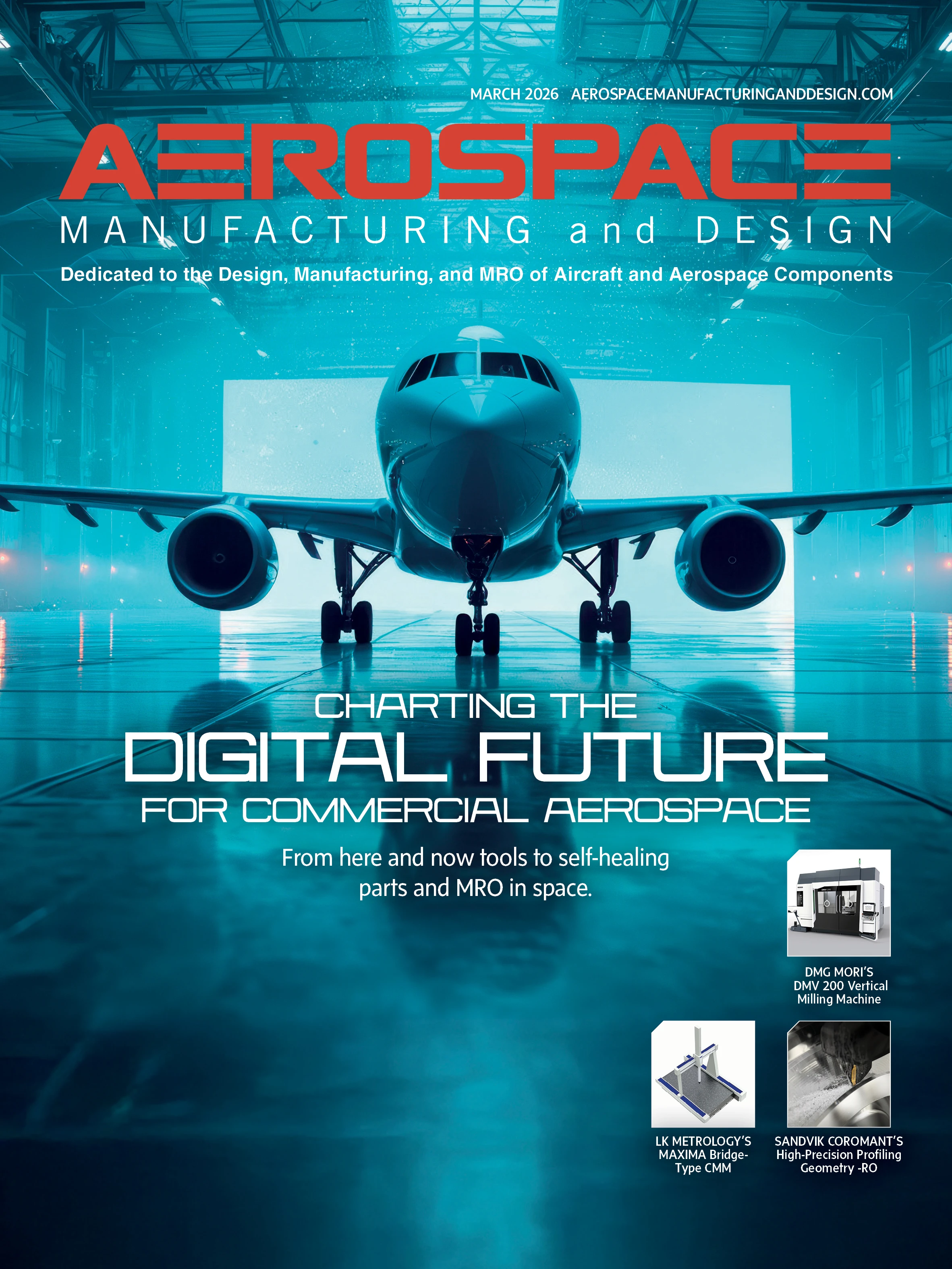
Explore the March 2026 Issue
Check out more from this issue and find your next story to read.
Latest from Aerospace Manufacturing and Design
- The Lee Company opens Innovation Center
- Precision XY gantry system
- Archer to test Starlink onboard its Midnight air taxis
- System eliminates cage-creep in sliding bearings
- Bodo Möller Chemie signs worldwide supply contract with Airbus
- Sandvik Coromant's CoroTurn Plus turning adapter
- ZOLLER Technology Days & Smart Manufacturing Summit May 13-14, 2026 in Ann Arbor, Michigan
- Walter's TC620 Supreme multi-row thread mill family