Space has always been the playground of the heroic few and sci-fi characters. It's been the final frontier of childhood dreams and adult fantasies. It has become a deep well of scientific discovery and has led to a multitude of yet-unsolved mysteries. The challenges of space flight have caused tragedies as well as miracles.
Now, investment, research and technology have been poured into a project to make the ultimate out-of-this-world experience a reality for those who haven't passed through NASA's stringent requirements to be an astronaut.
That's right – it's time to vacation to the stars.
Chasing a Dream
In 1999, the Virgin Group, founded by Sir Richard Branson, formed Virgin Galactic with the goal to invest in the development and construction of the world's first privately held spaceline. Not long after, Burt Rutan, CEO of Scaled Composites, competed in the Ansari X Prize contest, which required the design and manufacture of a privately-funded vehicle capable of delivering the weight of three people, including one actual person, to sub-orbital space. Funded by Paul Allen, co-founder of Microsoft, Rutan's SpaceShipOne won the prize on October 4, 2004, flying to space three times and becoming the world's first private manned space vehicle.
With Rutan's background and Virgin Galactic's intentions, the teams seemed like a perfect fit. Virgin Galactic struck an agreement with Rutan and Allen to invest in the development of a second-generation vehicle based off of SpaceShipOne for commercial venture. Virgin ordered five SpaceShipTwo's and three WhiteKnightTwo carrier aircraft to be manufactured by The SpaceShip Company, a joint venture between Scaled Composites and Virgin.
"Burt's was the first project that we saw that came close to our vision of how the problem of safe, energy-efficient, cheap access to space could be solved," explains Will Whitehorn, president of Virgin Galactic. "We gave Burt the challenge of producing a launch system for us that would allow thousands of people to fulfill their dream of seeing the beauty of space, the blue planet below them, and experiencing the weightlessness of zero-gravity."
SpaceShipTwo is currently being developed in Mojave, CA, at Scaled Composites. It uses all the same basic technology, construction and design as the SpaceShipOne prototype, but is about twice as large. The spaceship is able to carry six passengers plus two pilots in a cabin approximately the same size as a Falcon 900 executive jet. The entire fuselage is used as a passenger cabin – meaning there is no floor – and surrounded by large windows so that astronauts can have a perfect view of the Earth from above. The 100% carbon composite spacecraft operates on internal power after being released from WhiteKnightTwo at approximately 50,000ft.

A new technology developed by Rutan is SpaceShipTwo's feathering wings for re-entry. With past space missions, re-entry into Earth's atmosphere has always been considered a great risk. The feathered wings of SpaceShipTwo greatly reduce that risk by giving the spaceship extremely high drag. This allows the re-entry deceleration to occur at a higher altitude, reducing the forces and heating on the structure. In addition, the feathered configuration enables the ship to align itself automatically, reducing pilot operation and positioning the vehicle to the correct altitude.
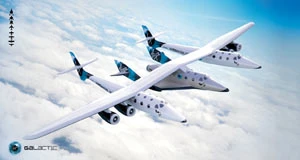
The WhiteKnightTwo carrier aircraft was rolled out in the Mojave Desert on July 28, 2008. Christened "Eve" after Branson's mother, the aircraft is now undergoing a rigorous test program.
This unique aircraft is the largest all-composite aircraft in service. (The Boeing 787 Dreamliner actually uses composite materials for less than 60% of its primary structure.) Its twinfuselage, open-architecture design holds the potential for a variety of vehicles to be launched into space, including unmanned vehicles. With four Pratt & Whitney PW308 engines, WhiteKnightTwo is one of the most fuel-efficient aircraft created in human history.
Though "Eve" looks flawless, it was not an easy structure to create.
"The challenges have been significant, and have included everything from the full-span composite wing structure, to the all-composite control cable system in the aircraft," admits Bob Morgan, lead engineer of WhiteKnightTwo at Scaled Composites. "Compared to the original WhiteKnight, this aircraft is triple the launch weight with the capacity for 12 more passengers."
Despite these challenges, the team is confident in their aircraft as flight testing begins.
"We expect this airplane to fly well," adds Rutan. "We know that we have risks and that there will need to be tweaks and modifications for it to fly at an optimum level. Even though this is a pretty weird airplane, we expect it to fly very well."
What 's the Difference?
NASA spacecraft were designed to carry large payloads and people into orbit and beyond, whereas the Virgin Galactic spaceship will only carry people into sub-orbit. However, specific design features of SpaceShipTwo represent innovative responses to safety and environmental concerns.
The original visions of space travel did not include huge, dirty explosions at ground level; however, that is what has become of launches to space. In addition, the separate solid and liquid rocket boosters used by the Space Shuttles spew thousands of pounds of debris into space and back to Earth. The air-launch of SpaceShipTwo eliminates both of these problems by using WhiteKnightTwo's power until 50,000ft, then using its single hybrid rocket motor for power to space.
The carbon composite structures of both WhiteKnightTwo and SpaceShipTwo enable the vehicles to be extremely fuel efficient, reducing the amount of pollution created in typical spaceflights.
Finally, NASA doesn't exactly have a stellar record when it comes to safety. The dangers of launch and re-entry are most significant, and have been addressed by Scaled Composites when designing SpaceShipTwo. Through the air-launch system and feathered wing designs, these risks are greatly reduced. In addition, there is no government-mandated launch schedule, and therefore The SpaceShip Company is able to thoroughly test their craft before launching.
"Government space flight does not have a reputation for safety even after 50 years," Whitehorn says. "And that's part of the nature of it, because it's exploratory. But if we can create the reputation of safety in the private and commercial sector and regularize space flight, it would be the most important single signal that one could send to allow a much greater level of investment in the private sector of space in the future."
Safety is at the core of the Virgin Galactic operation. The flight test program of WhiteKnightTwo will last at least 12 months to 18 months, or until the team is completely satisfied with the results. Flight simulations are currently being run in the Scaled Composites facility for pilots and future astronauts.
Changing Aviation as we Know it
The aerospace industry is shifting toward the use of more composites in the design of aircraft, as evidenced by the Boeing 787. However, WhiteKnightTwo and SpaceShipTwo have shown that it is possible to create strong, efficient aircraft out of 100% carbon composites. This opens the door for general aviation to follow The SpaceShip Company's lead.
"It's an interesting moment to be unveiling the world's first all carbon composite, high-altitude jet, and probably the most fuel-efficient aircraft ever developed in history," Whitehorn said at the WhiteKnightTwo roll-out. "Our sister company, Virgin America, has the most fuel-efficient fleet currently operating in the United States, and if they, and others, are able to source 100% composite aircraft, then they should be able to use 50% less fuel than they have to today."
According to Branson, the environmental impact of aviation is an extremely important issue that is often widely exaggerated. People sometimes single out aviation as a key component of climate change, Branson explains.
"While I believe that aviation must get much more carbon efficient than it is today, it is important that people realize that seemingly benign industries such as IT have in fact overtaken aviation in terms of their CO2 output, and seeing WhiteKnightTwo in reality sends the message that aerospace really can become much more efficient than other forms of transportation or indeed entire other industries, and at the same time, help them improve their environmental footprint."
Virgin is currently trying to push Airbus and Boeing into putting more composites into their fleets, according to Branson. Arguably, composites are just as strong or stronger than metals, and with the current fuel crisis, fuel-efficiency is at the top of the priority list. Branson predicts that all-composite commercial airplanes are in the near future. The difference between Virgin Galactic's system and other aircraft is that composites are being introduced bit-by-bit by prime manufacturers, says Rutan. Even the latest composite airliners and military fighters still include large quantities of metals.
"Where [composites and metals] come together is where there's corrosion and problems, and where they come together is where the costs are high, because you have tooling requirements for metal airplanes and you have tooling requirements for composite airplanes, and everything has to fit together," Rutan explains. "The thing that's different here is that [WhiteKnightTwo and SpaceShipTwo] are all composite. And that gives us much more significant advantages than a plane that's mixed."
If the Virgin Galactic venture proves to be a success, it will show that an all-composite craft is safe and efficient. "The success of WhiteKnightTwo really does matter," Whitehorn says; "not only in space, but to create the conditions for manufacturers to invest in composites as a contribution to the future of aviation and environmental efficiency worldwide."
Are We There Yet?
Virgin Galactic predicts that the first commercial flights will begin in 2010. Passengers will train for three days before embarking on a two-hour journey further away from home than they've ever been. Rocketing away from Earth at three times the speed of sound, passengers will be able to view space and Earth for 1,000 miles in every direction.
"If our new system could carry only people to space, that would be enough for me because of the transforming effect it will have on the thousands who will travel with us," Branson reflects. "It is quite clear from every astronaut that I have ever spoken to that seeing the planet from out there, surrounded by the incredibly thin, protective layer of the atmosphere, helps one to wake up to the fragility of the small portion of the planet's mass that we inhabit, and to the importance of protecting the Earth."
Explore the September October 2008 Issue
Check out more from this issue and find your next story to read.
Latest from Aerospace Manufacturing and Design
- Forecast 2026 Webinar
- America Makes announces two project calls worth $8 million
- Jaw force gauges
- Air India orders 30 Boeing 737 MAX jets
- Speed increasers for lathes, Swiss-style machines
- #81 Manufacturing Matters - Additive Manufacturing Analysis, Trends, Forecasts with Terry Wohlers
- A look at the latest in the defense industry
- Workholding Roundtable to feature expert insights on a booming market