The Phoenix Mars Lander that began scooping up samples of Martian soil June 4, 2008 depends on REALI-SLIM thinsection bearings to position its robotic arm for digging in the permafrost.
This is the second Mars mission for REALI-SLIM bearings, manufactured by Kaydon Corporation Bearings Division of Muskegon, MI. They were also used in the two 2004 Mars Exploration Rovers, which are still sending geologic findings back to Earth, some 171 million miles away.
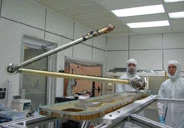
The robotic arm was built by Alliance Spacesystems of Pasadena, CA, for NASA's Jet Propulsion Laboratory. It is designed to trench the surface, pick up soil and ice samples, and deposit them in the Lander's instruments for testing. The 7ft 7" arm is attached to the deck of the Lander, with a garden-sized trowel on the end and a camera mounted above it that sends color photographs of the samples to scientists on Earth.
The arm has four types of motion: up-and-down, side-to-side, back-and-forth, and rotating. Three of the joints that accomplish these movements feature sets of custom-engineered REALI-SLIM thin-section bearings. According to Richard Fleischner, mechanical engineering group supervisor at Alliance, they were specified for several reasons.
"The Kaydon bearings give us plenty of load capacity, even though they are lightweight and small enough to fit in the tight space," he says. "They also have a full complement of balls to withstand the force and vibration of the launch. And we get good engineering support and a reasonable lead time from Kaydon."
Fleischner says the bearings take a heavy load during digging, as up to 100 lb or more of force is needed to break through the ice and dig down about 20". They are made of heattreated 440C stainless steel and mechanically honed to achieve a super-fine finish and improve torque. The bearings are heated to operate in extreme cold (the joints are designed to survive in -108°C) and use a low-outgassing lubricant that neither gets too viscous in extreme cold, nor evaporates in the thin atmosphere. kaydonbearings.com

Explore the September October 2008 Issue
Check out more from this issue and find your next story to read.
Latest from Aerospace Manufacturing and Design
- Archer to test Starlink onboard its Midnight air taxis
- System eliminates cage-creep in sliding bearings
- Bodo Möller Chemie signs worldwide supply contract with Airbus
- Sandvik Coromant's CoroTurn Plus turning adapter
- ZOLLER Technology Days & Smart Manufacturing Summit May 13-14, 2026 in Ann Arbor, Michigan
- Walter's TC620 Supreme multi-row thread mill family
- ThermOmegaTech achieves CMMC Level 2 C3PAO certification
- One-touch precision flex locators