The Supertanker fire fighting aircraft, developed by Evergreen International Aviation (EIA), delivers an 8:1 drop ratio, much higher when compared to other firefighting aircrafts. Natural disasters such as forest fires, oil spills and biochemical mishaps make it imperative to become proactive in minimizing the damage that these create. Upon receiving interim approval from the Interagency Air Traffic Board, and receiving certification for operation this year, Evergreen International Aviation (EIA) is helping reduce the amount of damage these disasters cause.
With more than 70 years of fire fighting experience, EIA has invested five years and $50 million of its own money into developing the Supertanker fire fighting aircraft.
According to EIA’s Project Manager, James Baynes, it took a team of 50 engineers more than 200,000 hours to turn a Boeing 747 into the Evergreen Supertanker. Featuring an 8:1 drop ratio, compared to other fire fighting aircraft, the Supertanker will forever change the way wildfires and other natural disasters are fought.
Fueled and Ready
When comparing the Supertanker with other fire fighting aircraft, the benefits become apparent. For starters, the Supertanker is fueled and ready for action 24/7. According to Baynes, one Supertanker is equivalent to seven other fire fighting aircraft and can spray water or fire retardant onto an area 100yd wide and three miles long by utilizing its four 16" wide nozzles that produce 40,000 lb of pressure. Fire fighting can be done in either one continuous drop, or over a multitude of segmented drops, giving Evergreen the opportunity to fight several fires in a single flight.
Additionally, the Supertanker has a payload of more than 20,000 gallons, and a response time in excess of 600mph. With refilling requiring only 35 minutes, it can be back in flight in a minimal amount of time. Having a centralized location means it can be anywhere in the country within 2½ hours and, by using six strategic fueling locations, the Supertanker can drop 90,000 gallons of retardant in a 16 hour period in segmented drops on multiple fires.
“Along with the favorable drop ratio, the Supertanker’s response time is twice as fast as any other federal air tanker,” Baynes explains. The majority of current air tankers used in the United States are vintage World War II era aircraft, designed for high altitude bombing missions. This makes it nearly impossible to be accurate when you figure in the wind and the altitude at which the retardants are being released.
The Real Cost
When comparing the real costs of natural forest fires, it is necessary to go beyond the cost of operating the Supertanker. The cost of calling the Supertanker into action is approximately $29,500 per hour with a five-day minimum contract. Matched up against the possible loss of hundreds of thousands of acres, thousands of homes, natural wildlife and, even worse, human lives, the cost should not even be a factor.
According to the National Interagency Fire Center (NIFC), in 1990, 60,594,824 acres burned in the United States alone, which is equal to the entire state of Oregon. And, these fires have cost an extraordinary amount of money to combat.
Since 1994, NIFC has recorded that the total cost of fighting these fires is in excess of $6.9 billion. “While this is certainly a lot of money, it does not come close to the total amount of damage these fires left behind,” Baynes says. “Our real efficiency will be realized when the Supertanker limits the duration of the fire, saving billions of dollars on the cumulative wildfire costs.” These cumulative costs include items such as property, timber and tourism losses.
In 2002 alone, NIFC states there were more than 88,000 fires that burned nearly seven million acres, generating a cumulative cost of more than $10 billion. When employed properly, the Supertanker has the capability to save the U.S. government billions of dollars every year in fire suppression, natural resource losses, and tourism and rehabilitation costs, not to mention saving homes, businesses and lives.

The Supertanker has a payload of more than 20,000 gallons of retardant housed in tanks
within the converted Boeing 747 fire fighting aircraft.
Early Success
The Supertanker made its first North American run on July 30, 2009, over the Railbelt Complex in Alaska. It made two drops from an average height of 300ft, using its patented pressurized system to dispense 20,000 gallons of a water-retardant mixture on the Railbelt Complex.
“This was the Supertanker’s first U.S. deployment. The mission was to help contain a flank of the large Railbelt Complex and aid in protecting an expensive new drill rig,” Baynes states. “The Supertanker performed a direct attack mission, dropping a mixture of 90% water and 10% retardant, while showing impressive results on the ground. These results were exactly what they expected after showing the same results during the U.S. Forest Service-administered grid tests back in March, 2009.”
Recent Usage
The state of California also took advantage of the Supertanker in its recent battle against the Angeles National Forest fire that erupted on August 26, 2009. With the ability to refill in only 35 minutes, the Supertanker was able to help fire fighting efforts in the state of California by making three drops to help contain the fires. The first drop was over the Oak Glenn fire in San Bernardino, while the other two drops were on the Station fire outside of Burbank. These drops were a complete success in the eyes of Incident Commander, Mike Dietrich. “They [Evergreen] did an excellent job to the point where it eliminated the need for us to backfire that section of the line.”
Based on the success of these two fire fighting missions, it’s easy to visualize the capabilities of the Supertanker in dispersing a variety of products in response to oil spills, soil stabilization, biological and chemical poisoning, and radiation. “We are able to carry and disperse any liquid or powder product, making it ideal for many other missions,” Baynes explains.
Looking Ahead
While EIA currently stations the Supertanker in Marana, AZ, its goal is to have ten Supertankers based throughout the world within the next decade. In fact, here in the United States, more than 50 military bases and 25 airports, ranging in locations from Miami, FL, to Richland, WA, have been identified as possible sites for EIA to establish base sites.
“We also plan on utilizing our advanced avionics technology to fly at night and drop from a higher altitude by using the pressure system,” Baynes states.
When asked what was next for EIA, Baynes believes, “The company will focus on increasing its capabilities with continuous improvements to its overall system, design and function.”
Evergreen International Aviation
McMinnville, OR
evergreenaviation.com
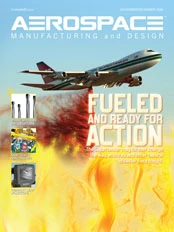
Explore the November December 2009 Issue
Check out more from this issue and find your next story to read.
Latest from Aerospace Manufacturing and Design
- Archer to test Starlink onboard its Midnight air taxis
- System eliminates cage-creep in sliding bearings
- Bodo Möller Chemie signs worldwide supply contract with Airbus
- Sandvik Coromant's CoroTurn Plus turning adapter
- ZOLLER Technology Days & Smart Manufacturing Summit May 13-14, 2026 in Ann Arbor, Michigan
- Walter's TC620 Supreme multi-row thread mill family
- ThermOmegaTech achieves CMMC Level 2 C3PAO certification
- One-touch precision flex locators