Advanced motion control technologies are essential to modern aerospace design, supporting a wide range of safety-critical and comfort-driven applications. Motion control components – such as gas springs, actuators, and dampers integral to nearly every commercial aircraft, rocket, satellite, and space vehicle – support flight safety and transport functions from the dependable deployment of landing gear and cargo doors to the smooth, ergonomic operation of seating for pilots and passengers.
Achieving rigorous safety, reliability, and performance standards often requires more than standard off-the-shelf components – it demands specialized motion control solutions designed to deliver reliable performance under unique specifications and extreme conditions.
“In many cases, the components must be fully or partially customized to meet specific application requirements. Even when development begins with a standard part, various modifications are frequently necessary such as changes in stroke length, force calibration, material composition, damping characteristics, and mounting hardware,” says Brian Ingoldsby, engineering manager at Melbourne, Florida-based Bansbach Easylift of North America Inc., a global supplier of motion control devices, systems, and components since 1919.
According to Ingoldsby, the process of modification or customization begins with evaluating the specific functional requirements, such as whether the component must counterbalance a load, provide damping, or perform consistently under defined temperature, pressure, or altitude conditions. Material selection is particularly important, as components must often meet weight, corrosion resistance, and fatigue criteria unique to aerospace environments.
“In aerospace engineering projects, key design considerations typically include space constraints, force output, mounting geometry, material selection, and environmental exposure. These factors are assessed in close collaboration with the customer, often resulting in a fully customized product tailored to the exact specifications of the application,” Ingoldsby says.
The specialized motion control components also must meet all necessary testing and classification requirements to comply with FAA and EASA regulatory standards. Each part must meet RTCA DO-160 testing standards, an international benchmark designed to ensure airborne equipment can withstand the harsh conditions encountered in aviation. This necessitates a deep understanding of certification protocols and the ability to manage the complete approval process.
For these reasons, a growing number of aerospace equipment designers are choosing to collaborate closely with motion control engineers from the earliest stages of a project. To facilitate such cooperation, companies such as Bansbach assign dedicated engineers to provide input, explore design options, offer technical recommendations, and develop solutions to enhance overall system performance.

“The ultimate objective is to streamline the OEM’s design process, reduce their development time, and ensure the final product meets the performance specifications,” Ingoldsby says.
Manual motion control
In aerospace systems, gas springs play a vital role in enabling safe, controlled, and ergonomic motion. From landing gear doors to access panels and cargo hatches that must remain safely open during maintenance or loading, gas springs provide the necessary force control and damping. Within the cabin, locking gas springs combine controlled motion with the ability to lock in a fixed position – a key feature in adjustable seating, stowable tray tables, and other reclining mechanisms.
Dampers are widely used to control motion, manage energy, and reduce vibration in various aircraft systems, such as in seating mechanisms and overhead storage compartments, and managing operation of service panels and cargo and passenger doors. Directional locking dampers allow manual force to override the position of the locking gas spring, supporting emergency use and maintenance operations.
Although gas springs and dampers share similar external appearances and basic operating principles across manufacturers, certain models are engineered with specialized design features providing distinct advantages.

Some standard offerings require OEMs to design around preset dimensions, but Bansbach can manufacture components to match customer specifications, such as gas springs with rod diameters from 3mm (0.12") to 70mm (2.75"), capable of lifting multiple tons.
The company can also incorporate design elements into its products beyond standard configurations, involving selection of materials, surface treatments, and internal components. As with many aerospace components, aluminum is often selected due to its significant weight savings over steel.
Advanced engineering features play a critical role in maximizing performance and extending product lifespan. For example, an integrated grease chamber can increase durability and support higher cycle counts than standard models. To further enhance longevity, the company applies a proprietary oven-cured surface treatment improving corrosion resistance and creating a smooth, durable rod finish without compromising seal performance. Treated gas springs typically last 3x to 5x longer than conventional gas springs.
Along with mechanical durability, thermal performance is critical. Aerospace components must operate reliably across extreme temperature ranges. Consequently, additional considerations for aerospace applications include specialty seals and oils formulated for extreme environments. Components may need to withstand temperatures up to 200°C near engines, while others must perform reliably in subzero conditions. To ensure consistent performance across this wide temperature range, the company employs advanced seals engineered for high- and low-temperature operation.
Automated motion control
Motion control components such as electric linear actuators provide precise, compact movement, although adoption within the aerospace sector remains limited. However, interest in the technology is steadily increasing, and electric actuators hold significant promise for future aerospace applications. For example, Bansbach’s EasyE electric linear actuators are available in a range of lifting capacities, with customizable stroke lengths up to 1,500mm and dynamic load capabilities up to 10,000N. The linear design allows for a compact installation footprint, while available accessories – including controllers and handsets – simplify system integration. Turnkey actuator kits further streamline deployment by eliminating the need for separate component sourcing, programming, or integration.
The value in high quality components
Using higher-quality, custom-engineered motion control components provides significant advantages for aerospace manufacturers. Whether through advanced gas springs, precision dampers, or electric linear actuators, the right components ensure equipment will operate smoothly and reliably for the expected lifespan, while meeting the rigorous standards of modern aerospace.
By working closely with motion control experts, aerospace designers ensure components meet the highest safety standards, streamline certification, and reduce development risks.
Bansbach Easylift of North America Inc.
https://www.bansbach.com/en/
NEWS AND PRODUCTS
RobCo opens San Francisco HQ
Robot-as-a-service (RaaS) company RobCo has expanded its launch in the United States with the opening of a new headquarters in San Francisco, California. In eight months, RobCo has established two assembly sites in Austin, Texas, customer operations across 14 states, and acquired the assets of the U.S. firm Rapid Robotics, including hardware, marquee customers, and an experienced local team.
RobCo’s RaaS offering combines proprietary modular hardware; artificial intelligence (AI)-powered, no-code software; and a shared risk, pay-as-you-go model whereby customers only pay when robots are running. Requiring minimal technical expertise to manage, the technology’s modularity allows companies to quickly pilot and scale automation of tasks including machine tending, palletizing, dispensing, and welding.
New research released by RobCo indicates 61% of American industrial companies are accelerating their automation initiatives amid the nation’s focus on boosting U.S. manufacturing capabilities, while almost all (95%) plan to add new automation solutions in the next 1-to-3 years. RobCo’s study also found 42% of U.S. companies are considering RaaS subscription models for financing.
“It’s a pivotal moment for American industry, filled with opportunity and demand for automation, as the nation focuses on reshoring industry and grapples with ongoing labor shortages,” says Roman Hölzl, RobCo CEO and co-founder. “By automating dull and dangerous tasks, American companies can increase productivity and take on new projects while attracting and retaining the next generation of talent by offering safer, more valuable, and fulfilling work.”
Founded in 2020 from the Technical University of Munich, RobCo has achieved backing by U.S. investors including Sequoia Capital, Lightspeed Venture Partners, and Kindred Capital.
New national standard for industrial robot safety requirements published
The Association for Advancing Automation (A3) has released ANSI/A3 R15.06-2025 American National Standard for Industrial Robots and Robot Systems – Safety Requirements. Available through A3’s website, the updated standard represents the United States’ national adoption of ISO 10218 and reflects the most significant update to industrial robot safety guidance in more than a decade.
Key updates include enhanced functional safety guidance, integrated collaborative robot application content, new classifications and test methods, and cybersecurity considerations.
The Association for Advancing Automation (A3)
https://www.automate.org
Automated loading/unloading tool handling platform

Whether loading/unloading a fully automatic presetting device (e. g. VIO linear), a fully automatic balancing machine (e.g., TD Preset Automatic Drive), a HAIMER Automation Cube, or a machining center, Automation Dock offers maximum flexibility in a loading/unloading platform for tool handling in a modern, automated manufacturing environment.
HAIMER
https://www.haimer.com
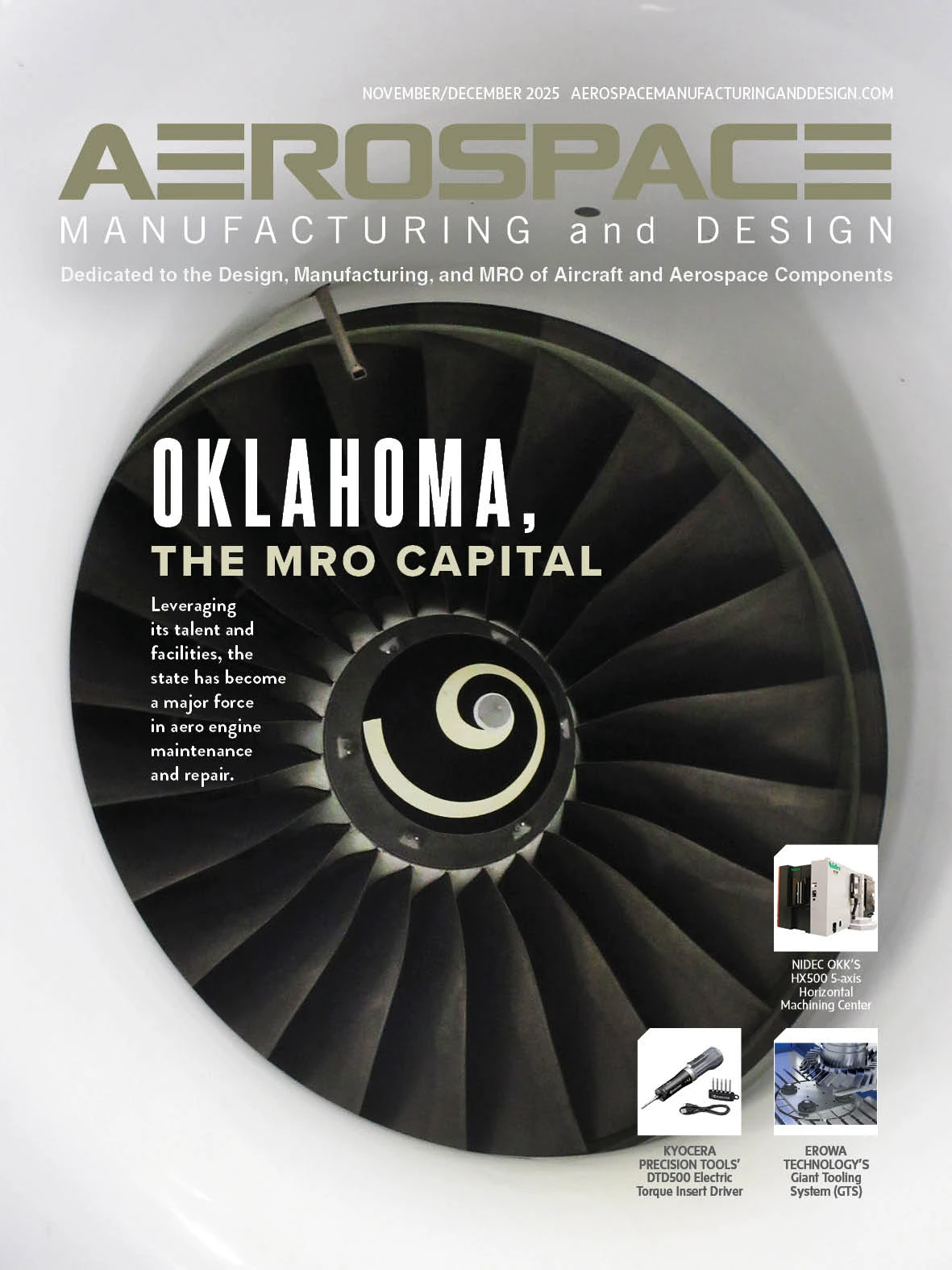
Explore the November/December 2025 Issue
Check out more from this issue and find your next story to read.
Latest from Aerospace Manufacturing and Design
- Dassault Aviation unveils the Falcon 10X
- Industrial round bumpers
- Defense Industry Trends webinar with Greenwich Capital Group
- Air Astana finalizes order for 25 Airbus A320neo family aircraft
- Syensqo showcases high-performance sustainable composites at JEC World 2026
- Multi-axis laser processing system
- Daher accelerates industrialization of thermoplastic composite upcycling
- Orizon Aerostructures deploys Flexxbotics platform