Editor's Note: This article originally appeared in the November/December 2025 print edition of Aerospace Manufacturing and Design under the headline “7 tools every aerospace shop needs.”

Aerospace manufacturing is exceedingly complex. The end goal – a precision-crafted component that can withstand harsh conditions and perform niche applications – is just one piece of the puzzle. Balancing component quality, budgetary restrictions, and production deadlines creates a high-pressure equation with little margin for error. What’s more, the question of how to get the job done introduces almost unlimited options. Suppliers offer recommendations for how to optimize the manufacturing process and achieve gains, and their technologies are constantly changing and improving. While the knowledge hurdle looms tall, staying ahead of the curve is key to maintaining an edge in an increasingly competitive market.
Among these considerations, selecting the right tools is paramount. And suppliers are continually innovating these tools to increase their longevity and provide a higher value-to-performance ratio. As new grades, geometries, and cutting methods develop, aerospace manufacturers who adopt innovative technology can stand apart, while those set in their ways will fall behind. The proper tool can make all the difference. Here’s where to start.
1. Plunge/high-feed face mills
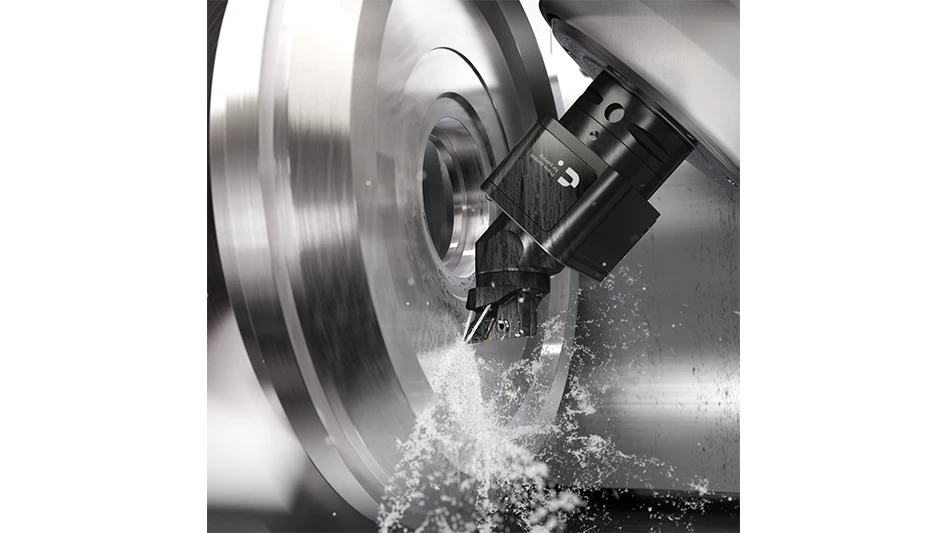
Consider adding a versatile, high-feed face mill to your tool crib. These tools excel in plunge and face milling, offering exceptional metal removal rates. Tools such as the CoroMill MH20 from Sandvik Coromant having an extreme lead angle on their bottom face can be particularly effective. As they make contact with the material, this style of high-feed cutter directs all the cutting forces toward the tool spindle, reducing the chance of unwanted vibration and deflection. In long-overhang applications, this enhancement is especially desirable.
2. High-feed side mills
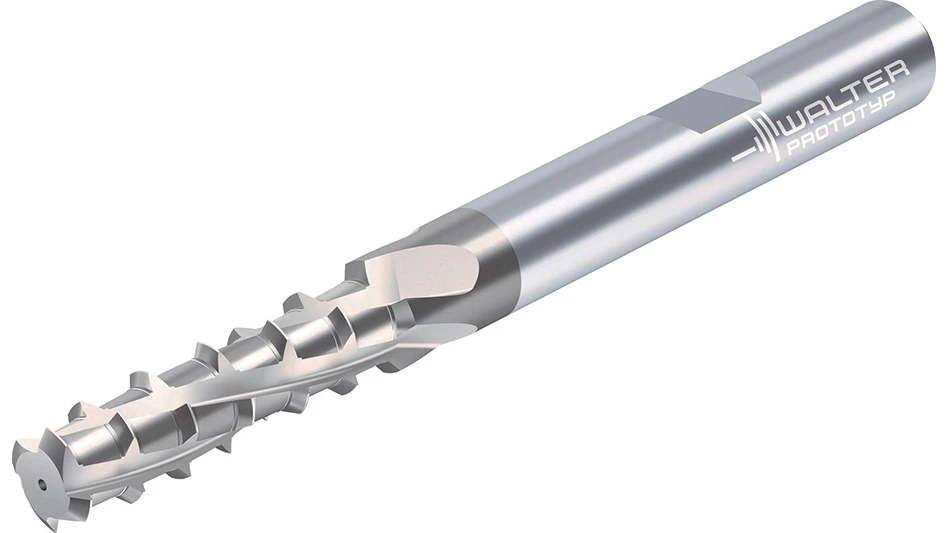
Similarly, high-feed side (HFS) mills allow manufacturers to take advantage of dynamic milling techniques to boost productivity. By leveraging a long, axial flute length and using a small radial depth of cut, the HFS mill will remove material efficiently and axially. This causes chip thinning, allowing a higher feed rate and metal removal rate than traditional cutting methods. Several tooling providers offer HFS mills specifically for aerospace applications, with tailored substrate coating, flutes, edge geometry, and coolant channels optimized for titanium and nickel alloys.
3. Specialized drills
The one-size-fits-all approach rarely works in aerospace machining, and drills are no exception. Instead of trying to cut costs by using general-purpose drills, opting for those tailored to aerospace applications will create repeatable, more consistent holes. For example, the 860 family of solid carbide drills from Sandvik Coromant, with variations optimized for nickel-based and titanium materials, are field-tested, proven solutions. The grades and edge prep of these drills are designed specifically for use on aerospace heat-resistant super alloys (HRSAs), leading to better quality and more repeatable results.
4. PCD tools
Polycrystalline diamond (PCD) tools – whether solid, coated, or veined – provide additional strength and precision, allowing higher-quality components and fewer errors in the manufacturing process. For aluminum alloys with high silicon content, they’re practically a must. But more aerospace manufacturers also could benefit from harnessing the gains of PCD in finish-turning titanium.
The additional life PCD tools offer compared to traditional, uncoated carbide options creates some compelling use cases for aerospace shops. Because each engagement and retraction site presents a potential failure point, using PCD to extend cuts can produce fewer fractures. When finish-turning larger titanium parts, PCD tools can cut continuously along an entire feature, saving time and reducing breakage.
Aerospace manufacturers should acknowledge they can’t achieve their goals as quickly or completely with carbide alone. The added cost of PCD tools can boost tool life, surface integrity, and dimensional accuracy enough to be worth the investment.

5. Ceramics
Ceramic cutters, whether milling tools or turning inserts, can machine nickel alloys with ease and very high metal removal rates. These characteristics make ceramic tools a must-have for aerospace shops engaged in rough milling or rough turning of nickel-based HRSAs. Compared to traditional carbide mills, ceramic mills can run at 10x to 15x the surface speed. In the turning realm, shops can achieve a 3x to 4x surface speed boost. While these innovations are only pertinent to nickel-based alloy applications and not titanium, the time savings can have a significant impact for shops looking to trim costs.
Furthermore, many ceramic cutters feature round inserts built in a neutral design providing multiple indexing possibilities for extended insert life and value.
6. CBN tools
Cubic boron nitride (CBN) tools have been used to machine steel alloys for decades. But in more recent years, aerospace shops have realized significant value in finishing nickel alloys such as Inconel 718 with these tools.
Similar to the value-add of ceramics, CBN tools can operate at up to 3x faster surface speed than traditional carbide finished turning solutions. Even with this notable production bump, CBN tools exhibit strong tool life, quality surface integrity, and dimensional accuracy. This results in a fast, precise, and highly repeatable machining process.

7. Tool holders
The tool holder is the unsung hero of aerospace machining. A proper tool holder helps eliminate vibrations while enhancing process security – translating to more precise cuts and longer tool life. In an industry requiring accuracy at each stage of the machining process, solutions such as the Capto tool holder from Sandvik Coromant help ensure each tool operates at peak performance.
When evaluating holders, opt for a rigid, stackable, and modular one. For titanium and nickel alloy machining, holders with high-pressure coolant capabilities are essential to maintaining accuracy in the cutting zone and reducing the number of scrapped components.
With these tools in the lineup, aerospace manufacturers stand well-positioned to balance productivity and performance while mitigating costs.
However, even the best tools can underperform if used incorrectly. Aerospace manufacturing requires a well-planned tool process combining the best tools with proper technique and cutter path theory to achieve high productivity and component quality. How to apply the tools is just as important to success as the tools themselves. Throughout every stage of the machining process, the right tooling partner can provide guidance and recommendations on which tools to use and how to maximize their effectiveness. They can advise on how to slow down into corners and when to slice out, how to properly roll in the cut on the engage, and how to handle the retract.
Tooling providers have their finger on the pulse of innovation, and they’re constantly engineering new solutions that can lead to real productivity wins. Ultimately, leaning into the knowledge and expertise of your tooling partner can make the difference between getting by and getting ahead.
Sandvik Coromant
https://www.sandvik.coromant.com

Explore the November/December 2025 Issue
Check out more from this issue and find your next story to read.
Latest from Aerospace Manufacturing and Design
- Assemble-to-order program for gundrilling machines
- #83 Manufacturing Matters - Workholding Roundtable
- Increase speed, productivity, and agility with automation technology
- Real-world manufacturing insights from industry experts
- The Lee Company opens Innovation Center
- Precision XY gantry system
- Archer to test Starlink onboard its Midnight air taxis
- System eliminates cage-creep in sliding bearings